




 GJO Home




Abstract
Mentoring is essential in training people in various occupations, since antiquity. It is often part of an overall educational program. This is laudatory, but I wish to describe another path, which I have used, along with the traditional one i.e., unofficial mentorship. These are defined by an individual, who has certain skill sets and is interested in teaching them to a varied interested audience. This has been a ‘modus operandi ‘, I have employed on occasion, in addition to conventual techniques. The philosophy of mentoring is briefly presented, along with my experience to hopefully increase understanding in our surgical community.
Keywords: ENT and Plastic Surgery; Modus Operandi; Surgical Community
Introduction
Epistemology is the branch of philosophy that investigates the natural, origin etc., of knowledge. Nagy et al. posits the origin of mentoring in the West, started and evolved from Homer’s Odyssey, whereby, Odysseus [human] underwent a perilous journey forging relationships, teaching skills and creating functioning teams [1]. It progressed over time [2]. Guilds [11-16 century] proliferated to teach importance skill i.e., wood- work, masonry, etc., The arts needed mentees to help with the craft [3]. Today mentoring is seen in many fields. Ryan notes 98 % of the Fortune 500 companies, have programs and find them valuable for all involved [4]. Fitzpatrick - Navarro further discusses this issue [5]. Medicine/ surgery has many official ways of promoting mentorships.
Mentorships in Medicine/ Surgery
Rakhit et al. present their model of mentorship i.e., its goals, expectations and methods [6]. They emphasize that both the mentor and mentee have responsibility for this to be successful. Socrates is renowned for establishing a method in philosophy, that is to this day important not only in medical education, but applicable to all other fields [7]. The American College of Surgeons has multiple programs , applicable for specific areas i.e., trauma [8]. A recent visit to facs.org showed not only areas engaged, but the College has mentoring information to help a surgeon throughout her career and life [9]. Specialty organizations i.e. Academy of Otolaryngology and Head and Neck Surgery [10], and American Society of Plastic and Reconstructive Surgery [11], have similar programs sanctioned by the ACGME and specialty boards. These programs have been helpful both during my training years and throughout my professional career, as program directors and chief of plastic surgery. However, I have found unofficial ad hoc relationships to be very satisfying to all involved.
Ad hoc Mentorships
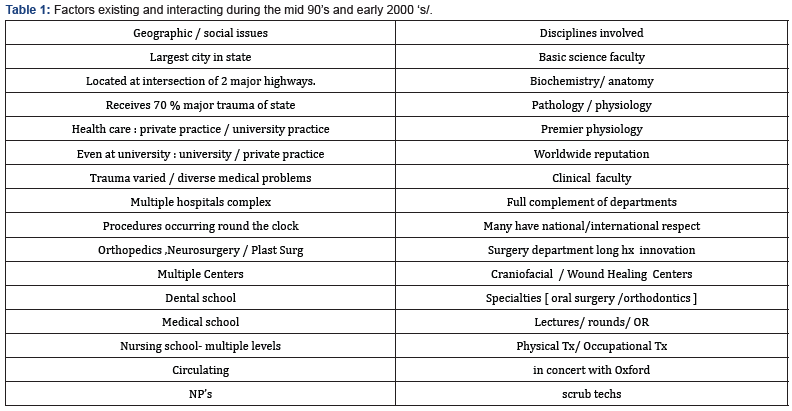
I working at the University of Mississippi Medical Center, was a wonderful / challenging experience. Table 1 shows factors existing and interacting during the mid-90’s and early 2000 ‘s. I was quite busy during this time as many of the faculty. I taught interns/residents primarily in the OR. I created a curriculum compliant with the ACME/ residency review committee. I had expectations of what techniques were needed, to be mastered at each stage of training. Thus, I and the rest of faculty could confidently certify each person could continue on their journey. It was essential during these years, we all evaluate those in the program regularly, and they also voiced their concerns. So , if a resident was not performing as expected, additional training was required. I interacted with everyone in the OR, and tried to teach everyone. I also learned a lot.
Since I left academic institutions, I continued to mentor those interested from my time in Watertown, NY and suburban Atlanta. I continue this practice, during last semester, and this one at UGA department of philosophy. It doesn’t only occur on campus, but at the neighboring Fairview. It is truly a unique community, from the hotel staff, but those who visit. Life is a journey. Interacting with diverse, smart and respectful people, is something I have always enjoyed. It wonderful that my mind, and enjoyment of civil interaction can still be satisfied. We can all be mentors if we care and try I!
References
- Nagy G (2016) The Odyssey’s Millennia-Old Model of Mentorship.
- Ferreres AR (2018) Brief History of Mentorship. Surgical Mentorship and Leader-ship.
- Editors (2026) Craft Guild -organization.
- Ryan E (2021) Mentorloop.com.
- Fitzpatrick-Navarro T (2026) Why mentorship is a must-have leadership strategy for 2025. Forbes-leadership.
- Ralchit S, Florentino MN, Stream JR (2024) Mentorship in surgery: Best practices, for mentor -mentee relationship. Cur Surg Reports.
- Farnsworth W (2021) The Socratic Method -a practitioner’s handbook. Godine Publishing, Boston, Massachusetts .
- FACS (2026) Mentoring excellence for trauma surgery.
- American College of Surgeons (2026) Mentor programs.
- Banyi N, Valenzuela D, Graham ME, Hu AC (2024) Mentorship in in Otolaryngology Head and Neck Surgery; A Scoping Review.
- Ruffolo A, Koljonen J (2023) Mastering mentorship : excelling as a mentor and mentee in residency and beyond.