




 JAICM Home



Abstract
ICU acquired weakness (ICU-AW) is a common complication in critically ill patients, significantly contributing to prolonged stays in the ICU and hospital, as well as long-term functional disability. It encompasses a variety of neuromuscular disorders that often overlap with involvement of the limbs and diaphragm, including critical illness polyneuropathy, critical illness myopathy and severe disuse atrophy. This narrative overview summarizes the current knowledge on the clinical features, assessment methods and modifiable key determinants of ICU-AW. Although the Medical Research Council (MRC) total score remains a cornerstone of bedside diagnosis for assessing muscle strength, ultrasound and electrophysiological techniques allow for the more precise detection of muscle wasting and peripheral nerve involvement, including subclinical abnormalities. Diaphragm dysfunction, which is often triggered or exacerbated by mechanical ventilation, plays a central role in delayed weaning and respiratory failure. Delirium, exposure to sedative and analgesic drugs (especially benzodiazepines and propofol) and inadequate or inappropriate nutritional protocols also contribute to the development and progression of neuromuscular dysfunction. Taking all these factors into account, it is clear that ICU-AW is a multifactorial systemic complication of critical illness that requires early diagnosis and comprehensive prevention strategies. This strategy should incorporate adequate and appropriate sedation, delirium prevention, patient-specific nutrition, diaphragm-sparing ventilation and inspiratory muscle training alongside early mobilization. A better understanding of these interactive mechanisms is expected to support the design of targeted interventions aimed at reducing the incidence of ICU-AW and mitigating its long-term impact on survivors' functional outcomes and quality of life.
Keywords: ICU-aquired weakness; intensive care unit; critical illness polyneuropathy; prolonged ICU stay
Introduction
Weakness, critical illness–related neuropathy and/or myopathy, and muscle wasting occur frequently in critically ill patients, and up to 80% of individuals admitted to the ICU develop some degree of neuromuscular impairment [1,2]. In those who survive, prolonged periods of mechanical ventilation and extended hospitalization are associated with more pronounced and persistent functional disability [1,2]. Subclinical neuromuscular alterations detectable with specific investigations may actually precede or exceed overt clinical weakness, and these changes have been shown to adversely influence patient outcomes [1,2]. Several mechanisms have been proposed to explain the development of critical illness polyneuropathy, including disruption of the blood–nerve barrier, reduced excitability of the endoneuria membrane, and direct neurotoxic effects of intensive care interventions such as hyperglycaemia or lipid-containing parenteral nutrition [3,4]. In the intensive care setting, respiratory distress is linked to difficulty in weaning from mechanical ventilation, longer ICU stays, increased healthcare costs, and higher long-term morbidity and mortality [3,4].
Weakness typically presents in a symmetrical pattern, involving all four limbs as well as the respiratory musculature, while the facial muscles are usually spared. Muscle tone is generally reduced, whereas deep tendon reflexes may be diminished or remain within normal limits. The diaphragm is commonly compromised, which contributes to prolonged dependence on mechanical ventilation and difficulty in weaning. Intensive Care Unit–acquired Weakness (ICU AW) is associated with critical illness polyneuropathy (CIP), critical illness myopathy (CIM), and profound disuse muscle atrophy. These entities often coexist, and the overlap of CIP and CIM—termed critical illness myopathy and neuropathy (CRIMYNE) or critical illness polyneuropathy and myopathy (CIPNM)—represents the most frequently observed mixed syndrome.
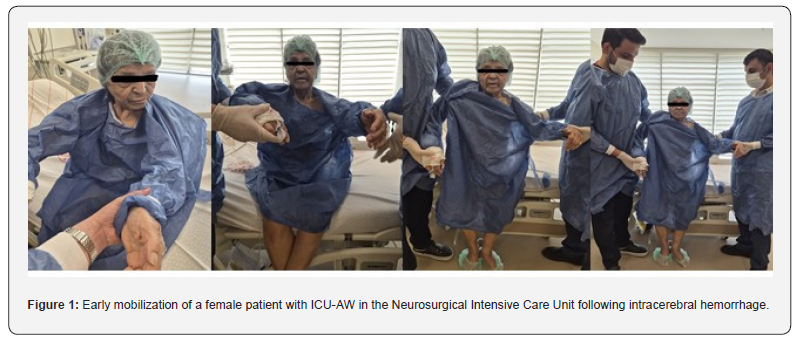
Grading of muscle strength is a key bedside method for assessing motor function. It is commonly termed manual muscle testing, muscle strength testing, or motor testing, and is routinely applied by clinicians, nurses, physiotherapists, occupational therapists, chiropractors, and other health professionals during orthopedic and neurological evaluations to detect focal neurological deficits, regional weakness, or generalized weakness related to deconditioning or aging. As an integral part of the neurological examination, muscle strength testing is especially useful in patients with stroke, traumatic brain injury, spinal cord lesions, and various neuropathies [5] (Figure 1.).
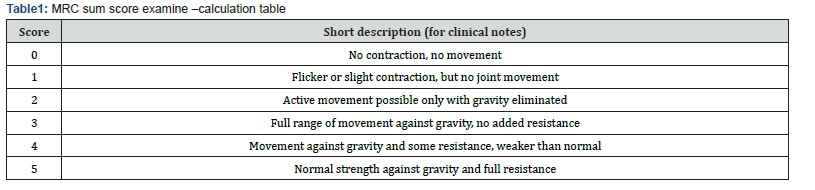
The Medical Research Council (MRC) sum score was used to quantify ICU acquired weakness. For each patient, bilateral shoulder abduction, elbow flexion, wrist extension, hip flexion, knee extension, and ankle dorsiflexion were graded from 0 to 5, yielding a total score ranging from 0 to 60 (Table 1). A value of 60 was taken to indicate normal muscle strength, whereas a score of 0 corresponded to quadriplegia.
Neuromuscular involvement in critical illness has been recognized for more than a century. In 1892, Sir William Osler described “rapid muscle loss” in patients with prolonged sepsis [6]. In the 1960s, Mertens reported polyneuropathy in comatose patients [7]. Later, in 2002, De Jonghe et al. observed ICU acquired paresis in 25.3% (24/95) of mechanically ventilated patients who had received ventilation for at least 7 days and were able to awaken and follow commands, defined by a manual muscle strength score below 48 on the MRC scale, indicating severe weakness with inability to overcome gravity [8]. Early work therefore established that profound muscle weakness is frequent, particularly in critically ill individuals requiring prolonged mechanical ventilation. Moreover, neuromuscular alterations can be documented objectively, with electromyography (EMG) and muscle biopsy serving as key diagnostic tools [2,9].
Diagnostic approach
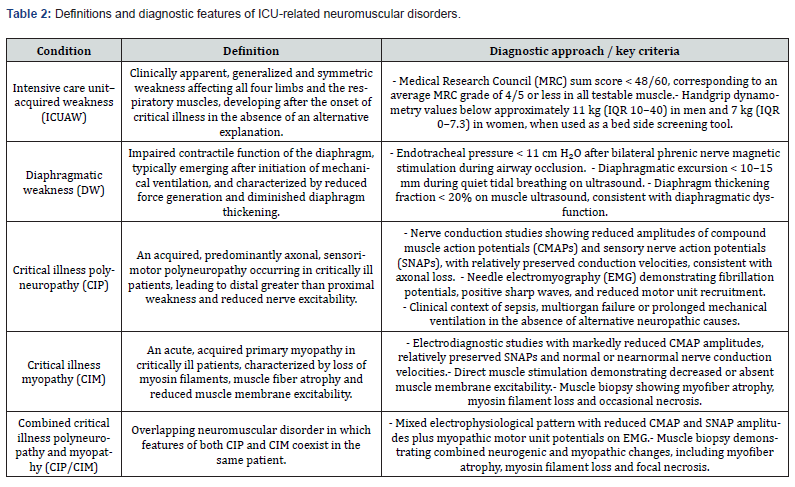
ICU acquired weakness (ICU AW) in critically ill patients is classically categorized into three main entities: polyneuropathy, myopathy, and muscle atrophy [Table 2]. In their work on quantifying muscle alterations in the ICU, Fazzini et al. primarily relied on ultrasound, largely because the equipment is portable and can be applied directly at the bedside, which is advantageous in unstable patients for whom transport is hazardous or unfeasible. In contrast, computed tomography (CT) necessitates moving the patient to the radiology suite, introducing additional risk for critically ill individuals.
Ultrasound assessments commonly focus on parameters such as muscle cross sectional area and muscle layer thickness. However, when examining the rectus femoris muscle, it has been demonstrated that relying solely on muscle layer thickness substantially underestimates ICU related muscle wasting compared with cross sectional area measurements [10]. Moreover, ultrasound derived quadriceps muscle layer thickness (QMLT) has not reliably mirrored true muscle loss when benchmarked against CT based measurements of muscle cross sectional area (CSA) [11].
Electrophysiological studies have identified a greater number of patients with ICU related weakness than clinical examination alone. This discrepancy likely reflects the inherent subjectivity of bedside clinical assessment, where detection of weakness is partly influenced by the examiner’s judgement, whereas electrophysiology is standardized and more sensitive to subclinical neuromuscular dysfunction.
Electrophysiological assessment follows standardized protocols with defined cutoff values and diagnostic criteria, allowing objective identification of neuromuscular dysfunction. Routine electrophysiology (EP) testing in patients with persistent weakness typically reveals abnormal spontaneous muscle activity together with reduced compound motor action potentials (CMAPs) and sensory nerve action potentials (SNAPs), findings compatible with a sensorimotor axonal peripheral neuropathy.
In these studies, motor nerves (most commonly the peroneal nerve) and sensory nerves (often the sural nerve) are stimulated at increasing intensities to provoke distal muscle depolarization, and deviations in the recorded action potentials indicate damage to nerves, muscles, or both. Critical illness polyneuropathy (CIP) is defined as a symmetric, distal, sensorimotor axonal polyneuropathy involving the limb and respiratory muscles and may also involve sensory and autonomic fibers [12–14]. EP investigations typically demonstrate pathological sensory and motor responses, whereas histological examination of sensory nerves in CIP often appears normal in the early disease phase, with overt axonal degeneration becoming evident only at later stages [13].
Diaphragmatic dysfunction and ICU-acquired weakness
Diaphragmatic dysfunction or weakness (DW), defined as a reduction in diaphragmatic force generation following the start of mechanical ventilation, is frequently observed in critically ill patients [15]. The concurrent presence of limb muscle weakness or paralysis together with respiratory muscle weakness, resulting in repeated failure to liberate the patient from the ventilator, is regarded as a characteristic clinical manifestation of this syndrome [16].
From a therapeutic perspective, ventilatory strategies that spare the diaphragm are recommended, aiming to preserve inspiratory effort during spontaneous breathing trials whenever a markedly elevated respiratory drive is not mandatory. In the setting of isocapnic or normocapnic hyperventilation, targeted inspiratory muscle training—using inspiratory resistance devices, threshold pressure loading, or optimization of ventilator trigger sensitivity—has been shown to: improve inspiratory muscle strength, enhance the likelihood of successful ventilator weaning, and shorten both ICU and overall hospital length of stay. Furthermore, structured respiratory muscle training administered after a successful spontaneous breathing trial can further augment inspiratory muscle performance and contribute to better quality of life in these patients.
Delirium, drug exposure, and cognitive impairment as determinants of ICU-acquired weakness
Delirium is a syndrome of acutely disturbed attention, awareness, and cognition that develops over hours to days and shows a fluctuating course [17]. It represents a critical complication in the ICU, reflecting decompensation of brain function—often described as “acute brain failure”—triggered by one or more pathophysiological stressors. With an incidence of approximately 20–40%, delirium, especially the hypoactive form, is linked to adverse outcomes, including longer duration of mechanical ventilation and prolonged ICU and hospital stay [18–19]. It is also associated with higher mortality and persistent cognitive deficits lasting up to 12 months after discharge [18–19]. Although delirium and ICU-acquired weakness (ICU-AW) are distinct entities, they likely share common pathways and may mutually exacerbate one another [3]. Both conditions are strongly influenced by the severity of critical illness. Benzodiazepines are well known to promote delirium and may also contribute to ICU-AW by fostering immobility [3]. Propofol and benzodiazepines, the sedatives most frequently used in intensive care, further potentiate the deleterious impact of bed rest by directly reducing muscle excitability [20]. Barbiturates and ketamine interact with N methyl D aspartate receptors, which are important for maintaining muscle trophism [20].
Nutrition and muscle weakness in the intensive care unit
Nutritional status is closely related to the development of weakness in critically ill patients. Early in the ICU course, critical illness is marked by pronounced skeletal muscle wasting, as demonstrated by reductions in rectus femoris cross-sectional area on ultrasound, together with hyperglycaemia and low circulating amino acid levels [21,22]. The key feature of this muscle loss is a profound catabolic state accompanied by impaired anabolic responses [23]. In the initial phase of critical illness, provision of calories and protein does not seem to reverse this catabolic milieu, and a degree of macronutrient deficit appears to be better tolerated than early full caloric replacement via parenteral nutrition [24]. Although high-dose amino acid supplementation is generally safe and well tolerated, even in patients with renal dysfunction, randomized controlled trials comparing higher versus lower protein intakes have yielded inconsistent findings [25–28].
Discussion
Neurosurgical intensive care unit (ICU) patients represent a uniquely vulnerable subgroup in terms of ICU-acquired weakness (ICU-AW), as they frequently present with severe traumatic brain injury, spontaneous intracerebral hemorrhages, aneurysmal subarachnoid hemorrhage, or complex spinal pathologies requiring prolonged immobilization and mechanical ventilation. In this context, distinguishing ICU-acquired weakness from disease-specific neurological deficits (e.g., post-stroke hemiparesis, focal spinal cord injury, or postoperative root lesions) is challenging but critically important, as ICU-AW is potentially preventable and reversible with appropriate supportive care and early rehabilitation. Recent studies on long-term outcomes following severe acute brain injury have shown that the course of functional recovery is often determined by the interaction of primary brain injury with secondary systemic complications such as ICU-AW, delirium, and malnutrition, highlighting the need for close collaboration between neurosurgeons, ICU specialists, and rehabilitation teams. In neurosurgical intensive care units, the implementation of structured early mobilization protocols, diaphragm-sparing ventilation strategies, and rigorous avoidance of deep, prolonged sedation can be particularly effective, given that these patients are at high risk for prolonged ICU stay and ventilator dependence.
Recent reviews indicate that, despite advances in intensive care, ICU acquired weakness remains very common, and early, standardized assessment is crucial to detect muscle weakness before it becomes clinically overt [29]. A broad evaluation of risk factors for ICU acquired weakness has confirmed the key contribution of sepsis, multiple organ failure, prolonged mechanical ventilation, deep sedation and immobility, all of which are frequently encountered in neurosurgical ICU patients with severe brain injury [30,31]. Current studies on early rehabilitation in the ICU suggest that structured mobilization and respiratory muscle training protocols may reduce the incidence and severity of ICU acquired weakness; however, in neurosurgical units their use must be carefully adapted to cerebral hemodynamic constraints.
A brief description of the literature search methodology
This narrative review is based on a focused literature search on acquired muscle weakness in critically ill patients, with particular emphasis on neurosurgical ICU populations. We searched PubMed/MEDLINE and Scopus for English language publications between January 2000 and April 2026 using combinations of the following keywords and MeSH terms: ‘ICU acquired muscle weakness’, ‘critical illness polyneuropathy’, ‘critical illness myopathy’, ‘diaphragmatic dysfunction’, ‘neurosurgical intensive care’, ‘severe acute brain injury’ and ‘early mobilization’. In addition, the reference lists of key articles and recent reviews were screened to identify further relevant studies. We gave priority to prospective cohort studies, randomized or quasi experimental interventional trials and high-quality narrative or systematic reviews dealing with the epidemiology, risk factors, diagnostic approaches, prevention and rehabilitation of ICU acquired muscle weakness, with particular attention to data applicable to neurosurgical ICU patients. Case reports and small case series were included selectively when they provided clinically informative descriptions in neurosurgical settings.
Conclusion
Muscle weakness developing in the intensive care unit is a common consequence of critical illness, resulting from overlapping neuromuscular dysfunction of limb and respiratory muscles, including the diaphragm. Early diagnosis is crucial for identifying both clinical and subclinical impairment. Diaphragm-sparing ventilation practices, careful use of sedative pharmaceuticals, prevention and treatment of delirium, optimized nutrition, and targeted strategies such as early mobilization and inspiratory muscle training can help reduce muscle loss, facilitate weaning from ventilator, and enhance functional recovery in patients surviving the intensive care unit.
References
- Hermans G, Van Mechelen H, Bruyninckx F, et al. (2015) Predictive value for weakness and 1-year mortality of screening electrophysiology tests in the ICU. Intensive Care Med 41(12):2138-2148.2
- Moss M, Yang M, Macht M, et al. (2014) Screening for critical illness polyneuromyopathy with single nerve conduction studies. Intensive Care Med 40(5): 683-690.
- Latronico N, Herridge M, Hopkins RO, et al. (2017) The ICM research agenda on intensive care unit-acquired weakness. Intensive Care Med 43(9): 1270–1281.
- Kelmenson DA, Held N, Allen RR, et al. (2017) Outcomes of ICU Patients with a Discharge Diagnosis of Critical Illness Polyneuromyopathy: A Propensity Matched Analysis. Crit Care Med 45(12): 2055–2060.
- Naqvi U, Margetis K, Sherman AL (2026) Muscle Strength Grading. Treasure Island (FL): StatPearls Publishing.
- Osler W (1892) The Principles and Practice of Medicine, Designed for the Use of Practitioners and Students of Medicine. New York: D. Appleton and Company.
- Mertens HG (1961) Disseminated neuropathy following coma. On the differentation of so-called toxic polyneuropathy. Nervenarzt 32: 71-79.
- DeJonghe B, Sharshar T, Lefaucheur JP, et al. (2002) Paresis acquired in the intensive care unit: a prospective multicenter study. JAMA 288(22): 2859-2867.
- Hermans G, Van Mechelen H, Bruyninckx F, et al. (2015) Predictive value for weakness and 1-year mortality of screening electrophysiology tests in the ICU. Intensive Care Med 41(12): 2138-2148.
- Puthucheary ZA, McNelly AS, Jai R, Connolly B, Sidhu PS, Rowlerson A, et al. (2017) Rectus femoris cross-sectional area and muscle layer thick ness: comparative markers of muscle wasting and weakness. Am J Respir Crit Care Med 195(1):136–138.
- Paris MT, Mourtzakis M, Day A, Leung R, Watharkar S, Kozar R, et al. (2017) Validation of bedside ultrasound of muscle layer thickness of the quadriceps in the critically Ill patient (VALIDUM study). JPEN J Parenter Enteral Nutr 41(2):171–180.
- Batt J, dos Santos CC, Cameron JI, Herridge MS (2013) Intensive care unit acquired weakness: clinical phenotypes and molecular mechanisms. Am J Respir Crit Care Med 187(3): 238-246.10.
- Bolton CF (2005) Neuromuscular manifestations of critical illness. Muscle Nerve 32(2):140-163.
- Witt NJ, Zochodne DW, Bolton CF, et al. (1991) Peripheral nerve function in sepsis and multiple organ failure. Chest 99(1):176-184.
- Demoule A, Jung B, Prodanovic H, et al. (2013) Diaphragm dysfunction on admission to the intensive care unit. Prevalence, risk factors, and prognostic impact-a prospective study. Am J Respir Crit Care Med. 188(2): 213–219.
- Bolton CF, Gilbert JJ, Hahn AF, et al. (1984) Polyneuropathy in critically ill patients. J Neurol Neurosurg Psychiatry. 47(11): 1223–1231.
- Pandharipande PP, Ely EW, Arora RC, et al. (2017) The intensive care delirium research agenda: a multinational, interprofessional perspective. Intensive Care Med 43(9): 1329–1339.
- Salluh JIF, Latronico N (2019) Does this critically ill patient with delirium require any drug treatment? Intensive Care Med 45(4): 501–504.
- Pandharipande PP, Girard TD, Jackson JC, et al. (2013) Long-term cognitive impairment after critical illness. N Engl J Med 369(14): 1306–1316.
- Urazaev AK, Magsumov ST, Poletayev GI, et al. (1995) Muscle NMDA receptors regulate the resting membrane potential through NO-synthase. Physiol Res 44(3): 205–208.
- Druml W, Heinzel G, Kleinberger G (2001) Amino acid kinetics in patients with sepsis. Am J Clin Nutr 73(5): 908–913.
- Fagoni N, Piva S, Marino R, et al. (2017) The IN-PANCIA Study: Clinical Evaluation of Gastrointestinal Dysfunction and Failure, Multiple Organ Failure, and Levels of Citrulline in Critically Ill Patients. J Intensive Care Med 885066617742594.
- Puthucheary ZA, Rawal J, McPhail M, et al. (2013) Acute skeletal muscle wasting in critical illness. JAMA. 310(15): 1591–600.
- Hermans G, Casaer MP, Clerckx B, et al. (2013) Effect of tolerating macronutrient deficit on the development of intensive-care unit acquired weakness: a subanalysis of the EPaNIC trial. Lancet Respir Med 1(8): 621–629.
- Doig GS, Simpson F, Bellomo R, et al. (2015) Intravenous amino acid therapy for kidney function in critically ill patients: a randomized controlled trial. Intensive Care Med 41(7): 1197–1208.
- Clifton GL, Robertson CS (1985) Contant CF: Enteral hyperalimentation in head injury. J Neurosurg 62(2): 186–193.
- Rugeles S, Villarraga-Angulo LG, Ariza-Gutiérrez A, et al. (2016) High-protein hypocaloric vs normocaloric enteral nutrition in critically ill patients: A randomized clinical trial. J Crit Care 35: 110–114.
- Allingstrup MJ, Kondrup J, Wiis J, et al. (2017) Early goal-directed nutrition versus standard of care in adult intensive care patients: the single-centre, randomised, outcome assessor-blinded EAT-ICU trial. Intensive Care Med 43(11): 1637–1647.
- Arzayus-Patiño L, Estela-Zape JL, Sanclemente-Cardoza V (2025) Safety of Early Mobilization in Adult Neurocritical Patients: An Exploratory Review. Crit Care Res Pract PP: 4660819.
- Chen J, Huang M (2024) Intensive care unit-acquired weakness: Recent insights. Journal of Intensive Medicine 4(1):73-80.
- Chuang YC, Shiu S, Cheng YY, Lee YC, Tsai YL, et al. (2025) Prevalence and Risk Factors of Intensive Care Unit-acquired Weakness in Patients With COVID-19: A Systematic Review and Meta-analysis. J Intensive Care Med 40:(10): 1042-1051.

























