



 JFSCI Home



Abstract
The availability of technology has revolutionized the examination of documents of new age crime. With the development of technology, the criminals are using innovative electronic gadgets such as computers, high resolution scanners and colour photocopiers to make forged documents. Such type of forged documents is extremely difficult to distinguish by common people. This paper deals with a case study where the fraudster used a high-resolution scanner and the computer adobe photo-shop software to transpose a genuine signature on Domicile Certificate. Non-destructive examinations of the questioned and admitted samples were performed on the various class and individual characteristics of the printing process under the high resolution microscopical techniques to scientifically prove the fraudulent features of the built-up documents in comparison with the genuine PRTC document.
Keywords: Fraudulent documents; Built-up documents; Transposed signature forgery; Forensic examination; New age crime; Peculiarities detected
Abbreviations: PRTC: Permanent Residence of Tripura; OBC: Other Backward Caste; ID: Identity Card
Introduction
New era of technology has significantly impacted the ways in which the documents are being forged in the scientific world. The very major concern is the use of modern and advanced tools to produce the built-up-documents that are also called as fraudulent documents or the manipulated documents which is purposed to deceive the government authorities or organizations, individuals or organizations requesting the government issues documents, etc. with an intention to perform the illegal activities. The advanced tools and technologies that are being used for the purpose of producing the fraudulent built-up-documents are extensively advanced, easily accessible, user-friendly interface, and are extremely difficult to differentiate from the original documents [1-3]. Few of these advanced tools are discussed below:
1. Sophisticated advanced editing software: For e.g.: Adobe Photoshop (which is used in the case discussed below) allows the users to produce and manipulate the images. It has various advanced features such as image enhancement, addition and deletion of contents without being detected, colour correction, etc. As a result of this user-friendly interface, and the availability of extensive features, Adobe Photoshop is majorly preferred to produce the built-up documents, and/or to forge documents such as wills, government issued ID cards, produce fake identity cards, and financial documents, etc.
Colour Printers and High-Resolution Scanners: The high-resolution scanners are usually the preferred mode of acquisition of the source documents which are then manipulated using the advanced editing software and then reproduced with the help of high-quality printers. The two types of printers discussed in this case study are Inkjet-printer and the Laser Printer.
a. Inkjet Printer (basics, and unique identification feature)
b. Laser Printer (Basics, and unique identification feature)
(Introduction to various computer-based forgeries with focus on transposed signature forgery) (Table 1).
Geographical Information
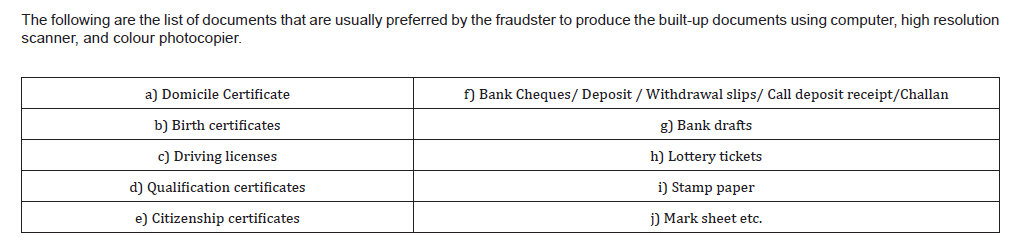
The state Tripura is in the north-east region having an international border and many crimes related documents are being committed by individuals/organizations, and the various criminal groups from the bordering country. Due to socio-economic, financial and many other factors related issues, inevitably many foreigners illegally enter the state producing fraudulent/built-up documents to the localities and to the government authorities, when requested. Notably, there are countable fraud agencies that are actively involved in the production of such built-up/ fraudulent/manipulated documents with a view to earn large income in the shortest duration. In this regard, a number of cases, concerning the increased fraudulent documents, were forwarded to the Forensic Science Laboratory for authentication of the documents using the scientific methods and methodologies.
It is not uncommon to receive documents that are with the distorting effect of the copying process and with loss of details that have been through multi generation reproduction. It is also considerably difficult to establish the authenticity of a file transferred through a network or cloud space. In many cases forgers apply ‘copy-cut-paste’ method also called as the “transposed method of forgery” to transplant (a) the genuine information, details, signature or the seals on to the built-up document, the forged document, the electronically edited documents to share via cloud space or (b) the fraudulent information, detail, signature, or the seals on to the genuine documents either in the physical form or in the digital form. As a result of the former, the meaning of the original documents is either changed, or an entire fraudulent document is constructed. Therefore, it is essential for the document examiner to acquaint with new advanced technologies used by the forgers to manipulate documents [4-6].
Types of possible alterations in documents
The documents that may contain a certain grade and range of changes either by addition of information to establish a new meaning or deletions of the already existing contents or information to modify the same are called altered documents. The alteration may also be done in various other ways such as erasure, interlineations, obliterations or overwriting, and/or insertion by copy paste method. There are various techniques preferred by the forgers and fraudsters to produce altered document namely (a) addition of text using paint and adobe Photoshop software, (b) addition and deletion of text by using high resolution scanner, and (c) cut, copy and paste of text from parent document to produce a fraudulent document by using high resolution scanner. The documents are traditionally altered either during their preparation or after their preparation. These altered documents require advanced scientific techniques for identification, detection, restoration and/or decipherment of original material or the altered portion of the parent document.
Case Report
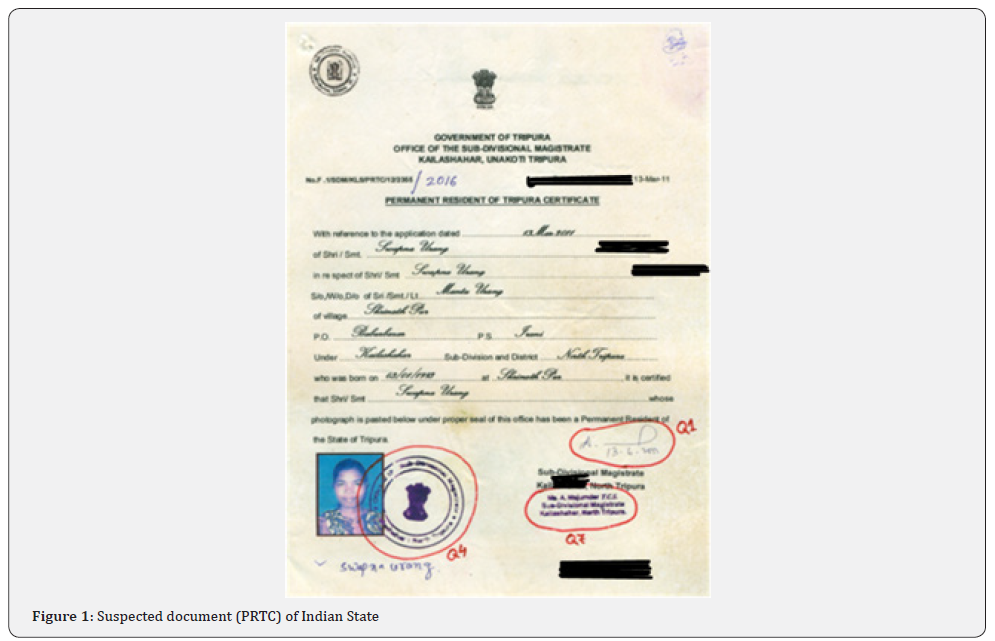
Few lawyers lodged complaints against an individual who allegedly provided a fake Permanent Residence of Tripura Certificate (PRTC) to a woman in exchange for a considerable amount of cash. The woman then tried to submit the PRTC at the Employment Exchange, Tripura, to get the government services but the officials of Employment Exchange denied the acceptance of the certificate questioning the authenticity of the document as the document was issued on Sunday, an official holiday in India. On receipt of the complaint, an issue was registered and the document was checked for its genuine. After a thorough and detailed examination of the received document, it was found that no such certificate was issued from the specific mentioned office. Further on scrutiny, one OBC-central government application, six numbers of income certificate application and seventeen numbers PRTC application were also recovered from the suspect (Figure 1).
Observation
On receipt of the complaints, the exhibit was collected using the standard and scientific protocol and examined using the physical and visual method of examinations such as the high magnification microscopy techniques. Various class and characteristics of the questioned exhibit was observed, analysed and compared with the genuine PRTC document. The observations are as follows:
Result and Discussion
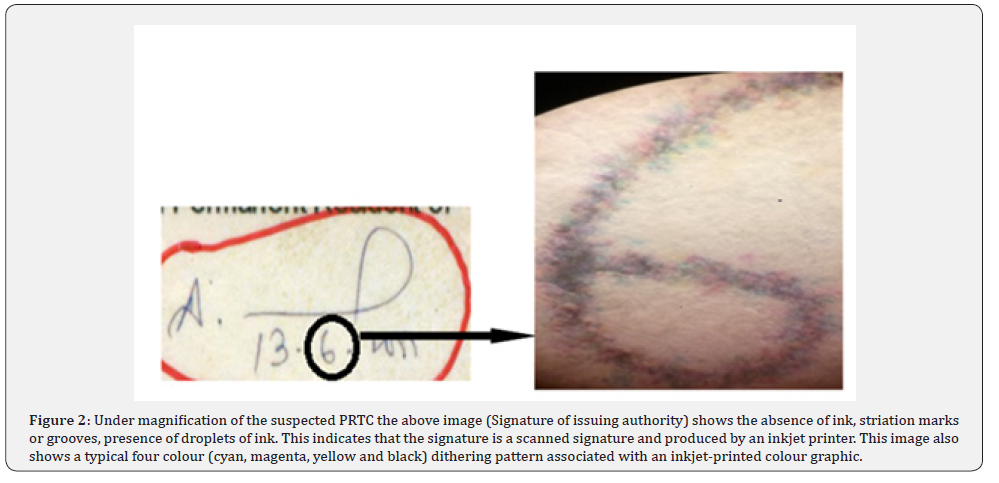
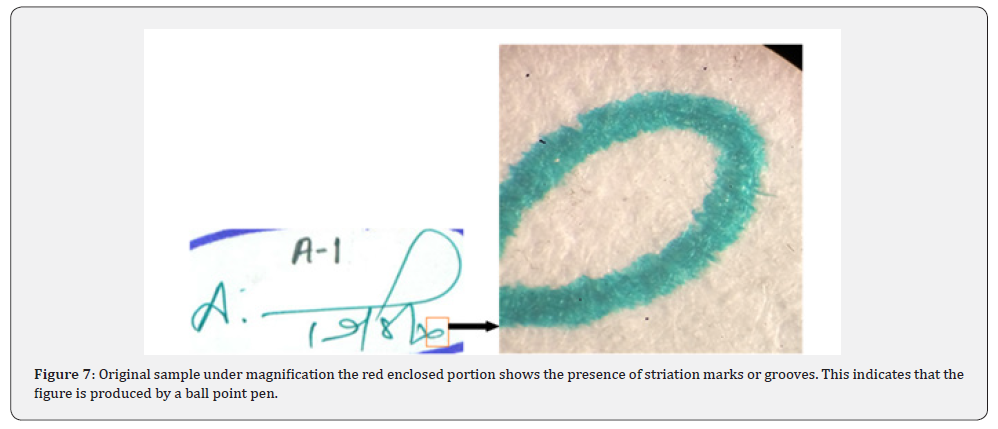
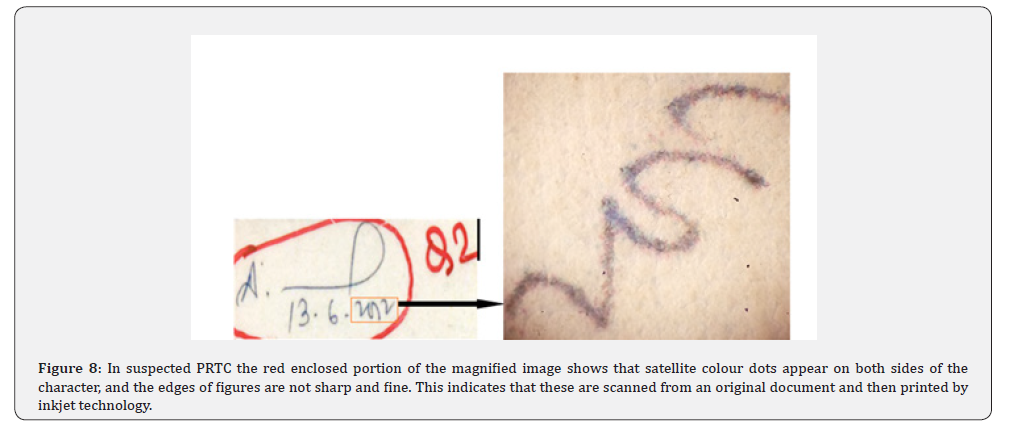
In photocopied transplantation of one genuine signature, it is obvious that the class and individual characteristics would be similar as the model which was transplanted was written by the genuine person. So, in such inquiries, the examiner has to prove that there is a cut and paste method of transplantation and the signatures used to create the fraudulent documents (PRTC) are the exact replicas of each other. Thus, this kind of fraudulent transplantations proves that (Figure 2) and (Figure 7,8) (disputed signature) are done by transplantation using scanned and photocopied method.
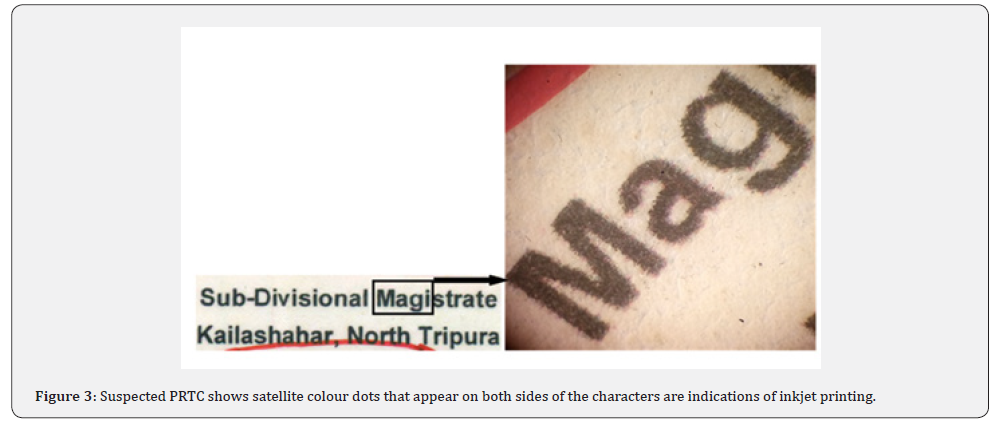
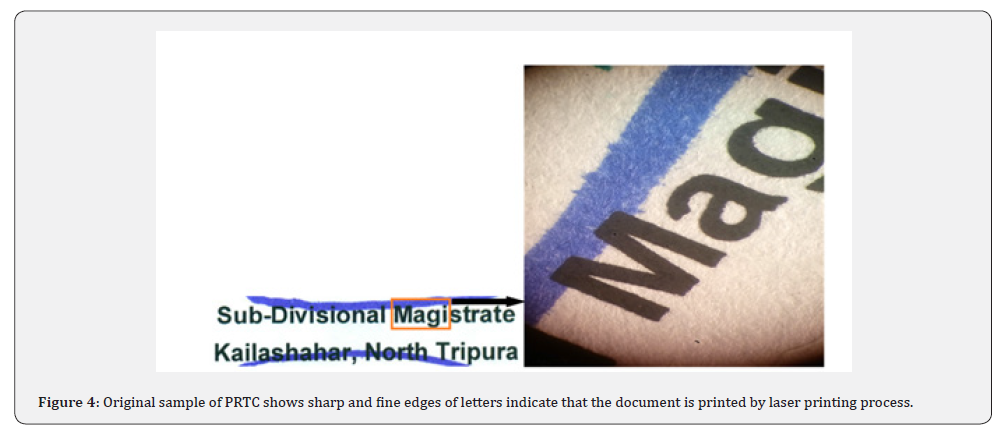
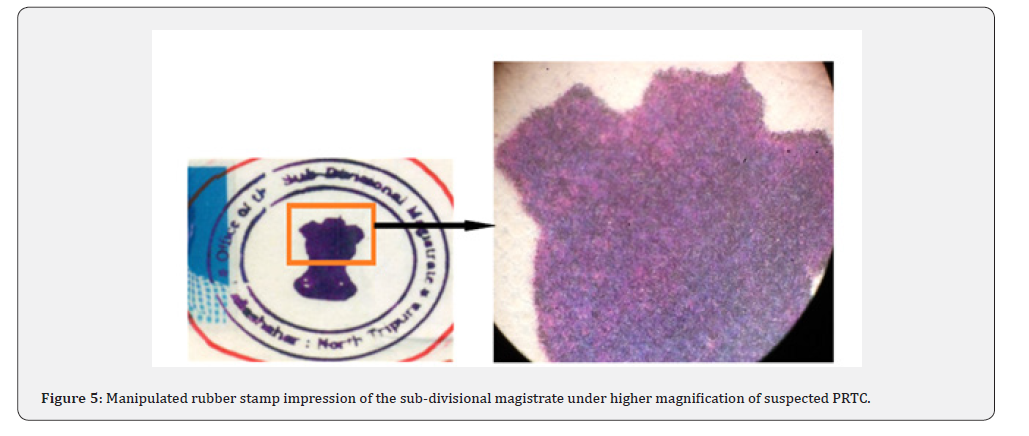
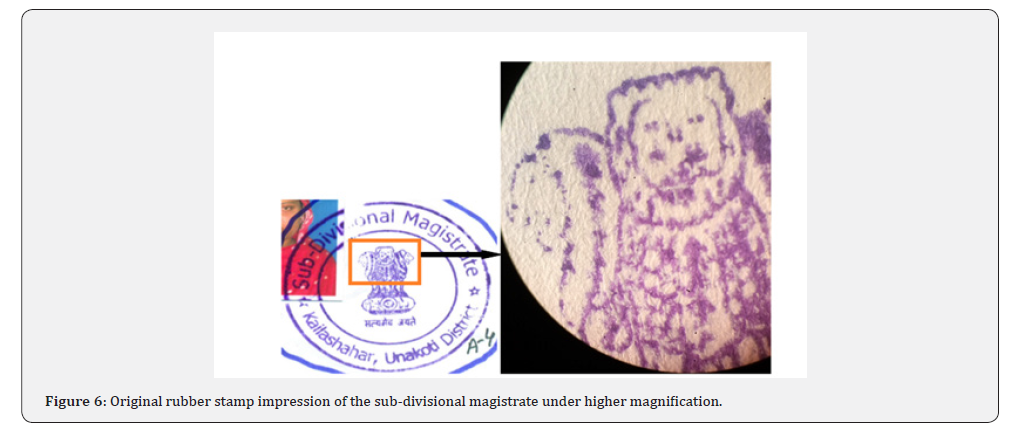
Moreover, the rubber stamp impression (Figure 5) used in the fraudulent document (PRTC) is found different as letter size, font style, alignment and spacing between letters when compared with standard stamp impression as shown in (Figure 6). The fonts and printing techniques used to create the fraudulent document (PRTC) are also found different as shown in (Figure 3) when compared with standard document as shown in (Figure 4).
Conclusion
Computer technology can blur how we define original vs. a copy as well as the physical distinctions between an original and a copy. It has become more difficult to distinguish photocopied from computer generated document. Image processing tools of computer are used for doing variety of document related crimes, manipulation of different government document, counterfeiting of currency notes, financial deeds, and educational certificate. Newly research shows that use of different type of tools of computer (copy past technology) is used for altered the document. So, document Examiner to keep up to date with new technology.
References
- Harrison WR, Handwriting. Suspected Documents and their Scientific Examination, 1st Indian reprint, Universal law publishing co. Pvt. Ltd, New Delhi, 1996.
- Baker JN. Law of Disputed and Forged Documents: Cases and illustrations.
- Huber AR, Headrick AM (1999) The Discrimination and Identification of Writing. Handwriting Identification Facts and Fundamentals, CRC Press, Boca Raton London.
- Jess Dines E. Document Examiner Textbook, Certified Document Examiner of Questioned Documents, Irvine, California, Pantex International limited, Irvine, C.A.
- Ordway Hilton (1984) Scientific Examination of Questioned Documents, Elsevier Science Publishing Co. lnc., New York, 56-67.
- Kelly JS, Lindblom BS. Handwriting Examination and the Courts. Scientific Examinations of Questioned Documents, 2nd edition, CRC Press, Taylor & Francis

























