



 JFSCI Home



Abstract
This case study investigates the suspicious death of an individual potentially caused by a lightning strike, focusing on the forensic analysis of a damaged cotton shirt submitted as evidence. Macroscopic examination revealed extensive tearing and shredding, while microscopic analysis using a stereo microscope disclosed frayed fibre ends and disruptions in the weave pattern. Notably, no signs of charging or discoloration were observed. The findings suggest a high-energy electrical discharge consistent with a lightning strike. This study has centered on evaluating the types of damage inflicted on fabric when an individual is struck by lightning. The paper exclusively examines macroscopic and microscopic fibre analysis, proposing that additional chemical analyses could be conducted to enhance the conclusiveness of the findings.
Keywords: Forensic Science; Textile Forensics; Forensic Physics; Thunderstorm Fatalities; Clothing Damage Analysis
Introduction
Lightning strikes are a significant cause of unnatural death, with approximately 24,000 fatalities reported annually worldwide [1]. Forensic science often relies on physical evidence, such as clothing, to ascertain the cause of death in such cases. Lightning, a powerful electrostatic discharge, generates intense heat (up to 30,000°C) and pressure, affecting various surfaces including skin and textiles [5]. On human skin, lightning can produce superficial burns-linear, punctate, or thermal-and the distinctive Lichtenberg figures which are fern-like, branching patterns caused by the high-voltage discharge traveling through the skin, appearing within an hour and fading within 24–48 hours due to electron flow inducing dielectric degradation and capillary leakage, though their exact pathophysiology remains under investigation [4].
Dielectric degradation refers to the breakdown or deterioration of a material’s insulating properties, known as its dielectric strength, when exposed to a high electric field, such as that generated by a lightning strike. In the context of skin or tissues, dielectric degradation occurs when the intense voltage from lightning overcomes the body’s natural electrical resistance, causing localized damage. This can lead to the formation of Lichtenberg fig ures as the electric current disrupts the skin’s structure, allowing energy to dissipate in a branching pattern [4]. Capillary Leakage is the process where the walls of tiny blood vessels (capillaries) become permeable, allowing fluid, proteins, or blood to leak into surrounding tissues. In lightning strike cases, the rapid electrical discharge and associated heat can damage capillary walls, leading to leakage.
This contributes to the temporary appearance of Lichtenberg figures on the skin, as the leaked fluid and blood create visible patterns that fade as the body reabsorbs them within 24–48 hours [4]. Clothing, particularly moisture-rich fabrics, may ignite, melt, or tear due to thermal expansion and electrical current, with damage patterns varying by fibre type. Frayed fibres, defined as textile strands that are split, unravelled, or irregularly broken due to mechanical stress or thermal damage, are commonly observed in such cases [3]. For instance, natural fibres like cotton and wool exhibit charging and fraying, while synthetic fibres such as polyester may melt or fuse due to lower melting points [3]. Charring is when something, like fabric or wood, gets burned or turns black because of intense heat. It happens when the material is exposed to high temperatures, like from a lightning strike, and the outside layer gets scorched or carbonized, making it look dark and crispy [3].
Fraying is when the edges or strands of a material, like cloth or rope, start to come apart or unravel. For fabrics, it looks like the threads are splitting or sticking out, often because of wear, tearing, or heat damage, such as what might happen during a lightning strike [3]. In cases where overt bodily injuries are minimal or ambiguous, forensic examination of clothing may provide crucial insight into the cause of death. This paper investigates the textile evidence from a suspected lightning fatality, with an emphasis on whether macroscopic and microscopic damage patterns on a shirt support the hypothesis of lightning involvement, despite the absence of expected thermal markers such as charring and decolouration. This study aims to assess whether the observed damage to the shirt, analyzed both macroscopically and microscopically, aligns with these characteristic effects, contributing to forensic protocols.
Case Report
A shirt belonging to the deceased was submitted to our laboratory
for forensic examination after the individual was found
dead during a suspected lightning incident. The investigating
agency specifically asked whether, based on the condition of the
clothing, it could be concluded that the death was caused by a
lightning strike. The evidence consisted of a cotton shirt displaying
multiple tears and discoloration. Macroscopic evaluation was
conducted using standard digital photography under controlled
lighting conditions. Microscopic analysis was performed with a
stereo microscope (ESAW STEREO PRIME WITH CAMERA, magnification
range 0.5X-100X) at various magnifications to study fibre
damage and discoloration patterns. The investigation compared
these observations with known effects of lightning strikes on textiles.
No chemical analysis or autopsy data were available at this
point; however, suggestions for such analyses are
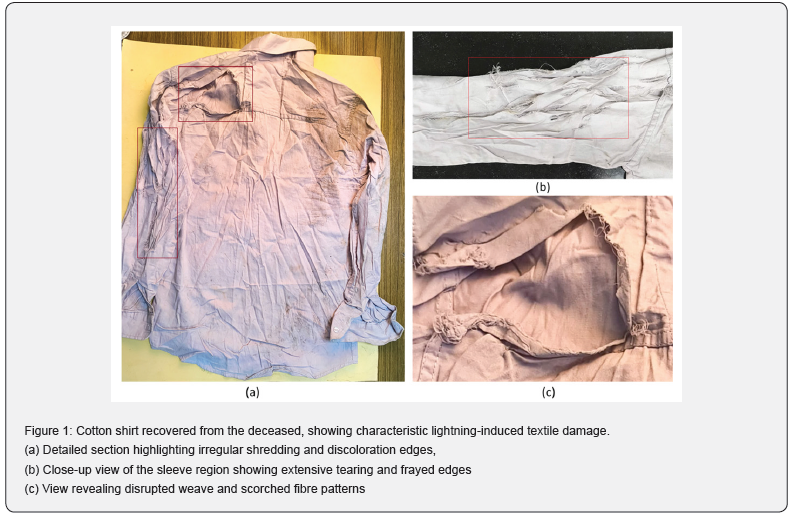
Macroscopic Findings: The shirt exhibited irregular, jagged
tears across the sleeve and body, with frayed edges (Figure 1).
These features suggest rapid expansion of moisture and air driven
by lightning’s thermal and electrical effects [2]. The lack of uniform
cuts or signs of mechanical wear points to a non-mechanical
cause.
Microscopic Findings: Stereo microscope images showed
frayed and split fibre ends, with some regions displaying yellowing
or browning likely from thermal changes (Figure 2a). The
weave structure remained intact in unaffected areas, but fibres
at tear sites appeared scorched, aligning with the impact of a
high-energy discharge [3].
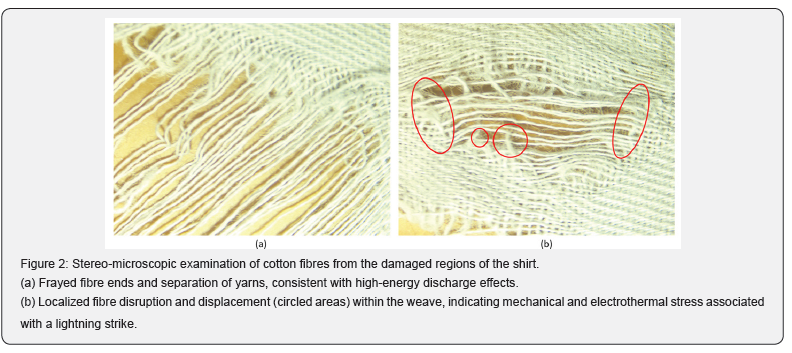
Typically, fabric weaving involves a warp and weft pattern, with warp threads running lengthwise and weft threads crosswise to create a stable structure. In microscopic images, the absence or severe disruption of either warp or waft, as observed at a marked point in (figure 2b) indicates exposure to extreme heat. Such conditions, like those from a lightning strike reaching up to 30,000 °C, can lead to rapid thermal breakdown, melting, or vaporization of fibres, resulting in the loss of one weave component [5]. This damage pattern is consistent with the intense energy of a lightning strike, which can selectively degrade fibres based on their heat resistance and moisture levels [3], supporting the hypothesis of high heat exposure.
Discussion
The combination of irregular tearing, fibre fraying and disrupted textile structure suggests the involvement of a high-energy electrical discharge. The lack of uniform mechanical damage (e.g., from tools or cutting instruments) further supports a non-mechanical origin. The absence of charring or burning does not weaken the hypothesis, as some lightning discharges may cause damage via pressure and internal vaporization rather than sustained heating [5]. Additionally, the observed loss of weave components at a microscopic level supports the notion of localized stress from a transient, high-voltage source.
The correlation between these textile findings and the potential presence of Lichtenberg figures reinforces the hypothesis of a shared electrical event [2]. However, the absence of chemical analysis limits the ability to detect residues like nitrates, which could confirm lightning involvement. This case underscores the utility of multi-scale analysis in forensic science and highlights the need for standardized procedures in lightning-related investigations, including chemical testing to identify specific residues and autopsy data to link skin and textile evidence.
Conclusion
The macroscopic and microscopic evidence-particularly the pattern of fiber fraying, loss of weave structure, and absence of mechanical wear-suggests the involvement of a high-energy electrical event consistent with a lightning strike. While these findings provide a strong preliminary case, the study’s reliance on visual and microscopic data alone suggests the need for further chemical analyses, such as nitrate residue tests or FTIR spectroscopy, to solidify the conclusion. Integrating these additional tests with autopsy findings could offer a comprehensive understanding of the incident. This research emphasizes the potential of textile evidence in resolving ambiguous causes of death and advocates for expanded forensic studies in this domain.
Acknowledgements
The authors express their sincere gratitude to Dr. S.K. Jain, Director-Cum-Chief Forensic Scientist, DFSS, and Dr. Rajiv Giroti, Director, CFSL Hyderabad, for their constant encouragement and support in carrying out research and development activities.
References
- Cooper MA, Holle RL (2013) Lightning injuries. Curr Sports Med Rep 12(2): 121-124.
- Cherington M, Walker J, Boyson M, Glancy R, Hedegaard H, et al. (2001) Closing the gap on the actual numbers of lightning casualties and injuries. Weather 56(3): 150-153.
- Zafar H, Ahmad S (2015) Forensic analysis of lightning strike injuries. J Forensic Sci 60(4): 1020-1025.
- DiMaio VJ, DiMaio D (2001) Forensic Pathology. 2nd ed. Boca Raton: CRC Press.
- Rakov VA, Uman MA (2003) Lightning: Physics and Effects. Cambridge: Cambridge University Press.

























