




 JFSCI Home



Abstract
The individualistic nature of our fingerprints makes the basic principle in the science of fingerprints, which makes every individual unique and thereby different. The current study aims to compare the fingerprint patterns of convicts arrested for murder and theft and establish whether same types of artefacts can be found on similar positions or not respectively. Artefacts can be defined as cuts, or cut marks, injuries that are present on the pattern areas of our fingers.
The study was performed on 50 samples whose analysis was done with digital Proscope and Stereomicroscope. The analysis of samples showed that maximum artefacts were seen in right thumb, left thumb and right index, left index, right middle and left middle respectively. The conclusion was derived that there are some similarities in terms of occurrence of artefacts present on fingerprints of criminals convicted for similar types of crimes. Reliability solely on the artefacts cannot be done for the purpose of identification.
Keywords: Fingerprint; Murder; Theft; Artefacts; Ridge dimensions; Ridgeology
Introduction
Forensic science has been used in crime investigation since decades now. It is known and believed to be a derivative of the Latin word forensis, meaning a forum, i.e, a group of people seeking justice [1]. The origin of this field is still in question nowadays but the earliest known usage in this field was seen in the 7th century in the country China [2]. Fingerprints are an important type of evidence that help in personal identification. The history of fingerprints dates to the ancient eras such as Babylonia and China. The mention of fingerprint patterns and palms has been recorded in ancient India in the book Samudra Shastra which gives individual characteristics of fingerprints i.e Apuran java, padam, kundla, bajjar, kamal, etc for fork, lake, island etc that are used in modern fingerprint science. Palmprints and fingerprints were used by Indian rulers such as Shahjahan and Aurangzeb for establishing authenticity to the documents along with seals [3].
Fingerprints can be defined as any marks or impressions that have been made on any surfaces via tips of a person which contain the friction ridges. The origin and development of fingerprints starts in the earlier stages of the pregnancy period. Our hands develop in the 5–6-week time and after that the fingers appear in the 6–7-week time. Volar pads appear on our palm surface that are basically the swelling of a tissue under epidermis. These pads appear on the fingers in 7–8-week time and become visible clearly till the 10th week respectively. After the development of these pads, the development of friction ridges starts. This development is thereby followed by formation of primary dermal grooves and ridges and sweat ducts, secondary dermal grooves and ridges and then finally the papillae [4].
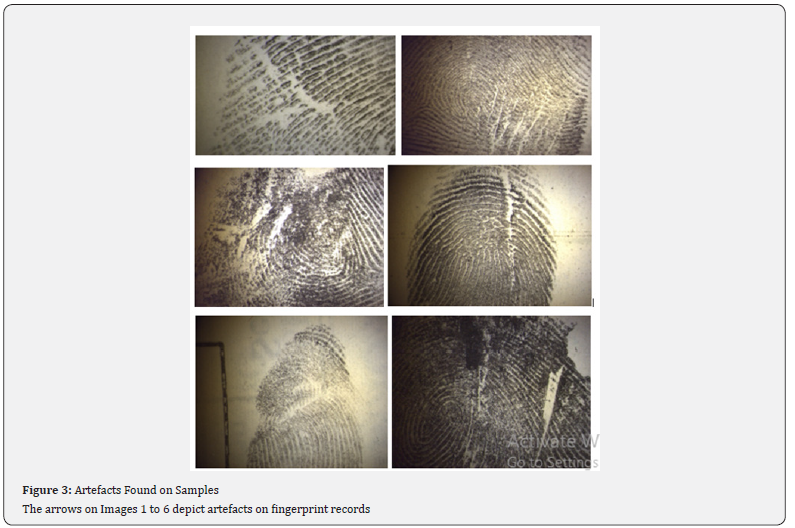
Artefacts can be defined as cuts, or cut marks, injuries that may be present on the pattern areas of our fingers. The presence of artefacts can be due to the job of the individual, surgical cuts or cuts due to involvement in some activities such as handling tools and sharp instruments etc. Sometimes obliterations in our fingerprint patterns by various individuals can also result in abnormal cut marks that are in fact artefacts. Artefacts can be found on many fingerprint impressions of individuals. Artefacts are also called distortions sometimes that involve cuts on the fingerprint areas. Crime can be defined as any action that is against the law and can be or is liable for any penalty or even punishment or both. There are different types of crimes that happen all around us nowadays. Some crimes like Murder and Theft are one of the most common crimes happening around our country and the whole world.
Materials and Methodology
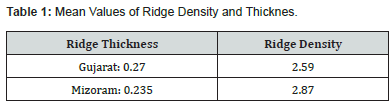
Total of 50 samples which were a combination of fingerprint slips of Gujarati and Mizoram criminals were analysed for the purpose of this study. The fingerprint slips were procured from the University itself for study and analysis purposes. The fingerprint slips were carefully sorted for specific crimes such as Murder and theft. The parameters for this study were Ridge thickness, Artefacts and ridge density. The ridge analysis was done including the ridge thickness and ridge density. Ridge thickness involved the thickness of 4 ridges taken in mm via measuring instrument and final average of 4 ridges gives us the ridge thickness.
The density of ridges was done by taking squares of dimensions of either 2mm or 5mm respectively. The squares were taken at extreme corners of the fingerprint such as Upper left, Upper right, lower left and lower right. The study for artefacts was carried upon via Stereo microscope respectively. Careful analysis of the rolled as well as plain fingerprints were done from the procured fingerprint slips. The instruments used for the analysis were USB Digital microscope and Stereo microscope respectively.
Results and Discussion
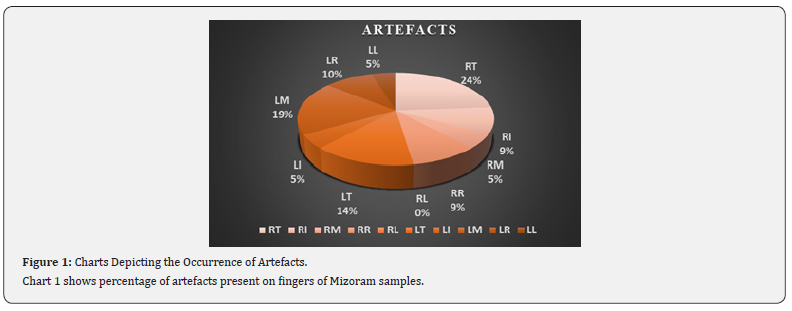
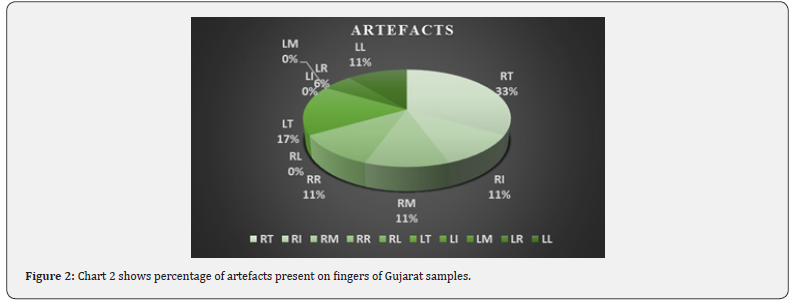
In terms of ridge thickness, Right Thumb, the maximum mean value was 0.357 and the lowest was observed in Mizoram that was 0.144. In case of ridge density, the maximum of 3.75 and 1.75 minimum was observed in right thumb in Gujarat samples. The artefacts occurrence for mizoram samples was maximum in Right Thumb finger with 24% and followed by 19% in Left middle, followed by 14% in Left thumb, followed by 10% in left ring, 9% in both right ring, right index, 5% in right middle and left index and left little and least in right little which was 0%. Meanwhile on the other hand the Gujarat samples exhibited maximum percentage in right thumb, which was 33%, followed by 17% in left thumb, 11% in right index, right middle, right ring and left little, followed by 6% in left ring and the lowest in right little and left middle which was 0% respectively (Table 1, Figure 1-3).
Conclusion
The aim of this current study was to compare the fingerprint records of criminals of two different domains who have been convicted for same type of crimes such as Murder and Theft. This study explores the artefacts found on various fingerprint pattern areas along with their comparison, occurrence and the ridge morphometrics and morphology respectively. Based on the results of the artefacts it can be said though not certainly (due to little sampling) that artefacts can be found maximum in either of the thumbs and index and middle fingers because these mainly aid in primary gripping of the objects such as weapons used in violent crimes.
According to the analysis and the data obtained it can be concluded that there are some similarities in terms of occurrence of artefacts present in the fingerprints of criminals convicted for the similar types of crimes. The occurrence of artefacts could be related to the crimes one has committed or has been indulged in some criminal acts. For identification purposes nowadays, the experts rely on the ridge characteristics. The weird obliterations and distortions present in fingerprints of criminals can indicate foul play. We live in a technological world and therefore crimes such as Biometric fraud are also on the rise. Nowadays many cases have been observed around the world wherein individuals have been known to undergo extensive measures such as burning via acid, plastic surgery to hide and conceal their identity and therefore result in not getting caught by the authorities. Many famous cases, like John Dillinger and Lin Ring, have come to light for biometric fraud [5].
References
- Anand Ranganathan SR (2017) The Forgotten Indian Wizards and the Birth of Modern Forensics.
- Williams J (2019) 3 Major Types of Fingerprints.
- Webb D (2007) All about forensic science. Retrieved from history of forensic science.
- Wertheim K (2011) The Fingerprint Sourcebook. (A. Mcroberts, Ed.) Washington: National Institute of Justice.
- Watson S (n.d.) How Fingerprinting Works.

























