



 JFSCI Home



Abstract
Bloodstain Pattern Analysis (BPA) is a methodological approach that is used for the interpretation of bloodstains collected from crime scenes to deduce the events that have taken place. Traditionally, BPA has been considered a subjective type of forensic evidence owing to its dependence on the analyst’s interpretation, lack of repeatability, and the difficulties involved in the interpretation of complex bloodstain patterns. The recent development of rapid breakthroughs in Artificial Intelligence (AI), including Machine Learning, Deep Learning, and Computer Vision, has made it possible for BPA to utilize AI to automatically detect, segment, classify, and reconstruct bloodstain patterns in three-dimensional space.
This review aims to explore the use of hybrids of physics-driven models and AI-based models, which can improve the accuracy, reliability, and interpretability of BPA. Additionally, it explores the key challenges of AI-assisted BPA, including material properties, data availability, generalizability of AI models, decision-making, ethics, validation, and the lack of standardized protocols. The final section concludes that the acceptance of AI-assisted BPA results should be based on standardized protocols and reviewed by a few experts to ensure scientific validity.
Keywords: AI: Artificial Intelligence; BPA: Bloodstain Pattern Analysis; Computer Vision; Deep Learning; Machine Learning
Abbreviations: AI: Artificial Intelligence; BPA: Bloodstain Pattern Analysis; SVM: Support Vector Machines; k-NN: k-Nearest Neighbors; CNNs: Convolutional Neural Networks
Introduction
Artificial intelligence (AI) is at the forefront of a paradigm shift in forensic bloodstain pattern analysis (BPA), shifting the focus from interpretation-driven expert consensus to scientific and reproducible analysis [1]. Historically, BPA has been an essential component of crime reconstruction, allowing analysts to reconstruct the chronology of events, the force dynamics of injury, and the positional orientation of individuals through the analysis of bloodstain patterns and characteristics [1]. On the other hand, traditional BPA methods have been susceptible to interpretation bias, human error, and a lack of replicability, thus rendering the method itself questionable from both scientific and legal perspectives [2].
Recently, the application of AI, such as machine learning, deep neural networks, and computer vision, has greatly improved BPA, allowing forensic analysts to automate the process of bloodstain detection and classification, as well as event reconstruction, with greater efficiency and potentially greater accuracy [3,4]. This is revolutionizing BPA from a biased and subjective method of analysis to a scientific and evidence-based one, reducing error-prone aspects and improving inter-laboratory and inter-analyst consistency, allowing for rapid analysis of large and complex data sets [5-7]. This review discusses the technological shift in BPA by assessing the benefits and limitations of AI-assisted bloodstain pattern analysis as shown in Figure 1. Thus, the scope of the discussion will also include validation, implications, and future applications of artificial intelligence, paving the way for bloodstain pattern analysis from interpretation bias to improved evidentiary strength.
Background
Bloodstain pattern analysis (BPA) traces its origin in studies conducted in the late 19th century and was substantiated by forensic scientists in some influential legal cases. BPA is a central forensic domain that reconstructs crime scene events based on morphological assessment which includes bloodstain size, shape, location, and distribution [1,8,9]. It is based on the principles of biology, physics, and mathematics, used for inferences about mechanisms of injury, movements of the victim and suspect, and how events unfolded.
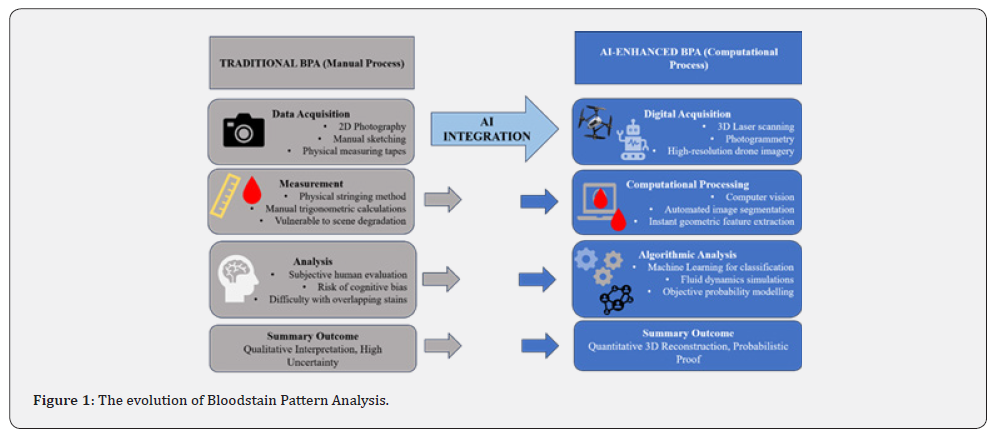
Investigators have relied on expert opinion to classify stains, and make postulations about the event using visual interpretation, image documentation, and modelling to record and interpret blood evidence [1,5,9]. In spite of its contributions, historical BPA has consistently encountered challenges related to the inherent observer bias in pattern assessment recognition, as well as how individual experts considered the results. Now, faced with enhanced multifaceted nature of crime scenes (especially when stains overlap, or mechanisms are mixed, samples are degraded), the limitations of human subjective analysis became evident [4,5,9].
Methodology
This review highlights how artificial intelligence is currently used in bloodstain pattern analysis and adopts a narrative approach to provide a holistic perspective on the applications of AI in BPA, integrating current methodologies, trends, and future perspectives, instead of a systematic review or meta-analysis. Using key databases like PubMed, Scopus, Web of Science, Google Scholar, and forensic databases such as the NIST OSAC Registry, the search was conducted. Publications between 2010 to 2025 are included. The keyword searches used combinations of terms including but not limited to “Bloodstain pattern analysis”, “BPA”, “AI”, “Machine Learning”, “Computer Vision”, “Deep Learning”, “Forensic Automation”, and specific models (e.g., Convolutional Neural Networks, and Segment Anything Models). The review includes studies that have implemented AI and machine learning in BPA. The grey literature, conference proceedings, and preprints on arXiv were also screened for studies that appeared to be emerging in this area.
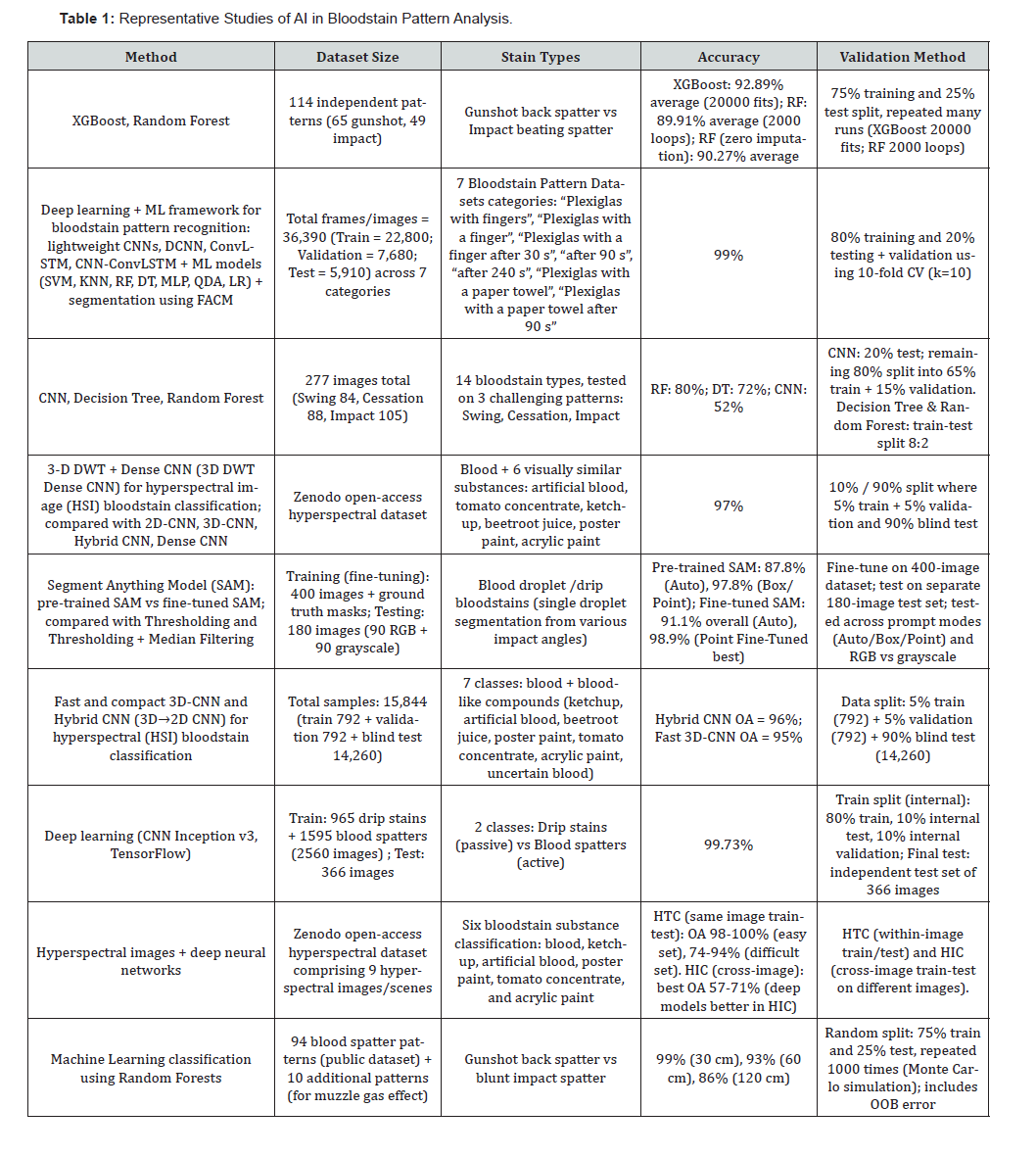
To reflect progress in real time, both peer reviewed papers and early release findings were included for this review. The studies included in Table 1 were chosen based on the criteria that they represent the most methodologically informative AI-based BPA research, particularly those studies that have specified the characteristics of their datasets, stain categories or tasks (e.g., classification, segmentation, reconstruction), and have quantifiable performance results such as accuracy or other forms of validation. Preference was given to studies that have specified their modelling paradigm, number of samples, and validation procedure (e.g., train-test split or cross-validation), thus making it possible to make comparisons across studies. This allows Table 1 to be used as a synthesis of the current state of AI research in BPA, as well as providing insight into the trends and challenges in dataset construction and validation.
Fundamentals of Bloodstain Pattern Analysis
BPA is divided into three groups, depending on the mechanism of blood deposition: passive (dripping or pooling due to gravity), transfer (contact between bloody and clean surfaces), and projected (blood spatter due to applied force). Each group has distinctive morphological characteristics useful for forensic analysis of events [15,16].
BPA is based on the principles of fluid dynamics and the inherent
physical properties of blood, such as non-Newtonian properties
and surface tension, to interpret stain characteristics. The
important parameters used in the analysis are:
• Impact angle: estimated from the width-to-length ratio
(sin θ = w/l)
• Origin area: established by trajectory analysis (manual
stringing or computer-aided techniques)
• Pattern distribution: gives information on the mechanism
and sequence of events
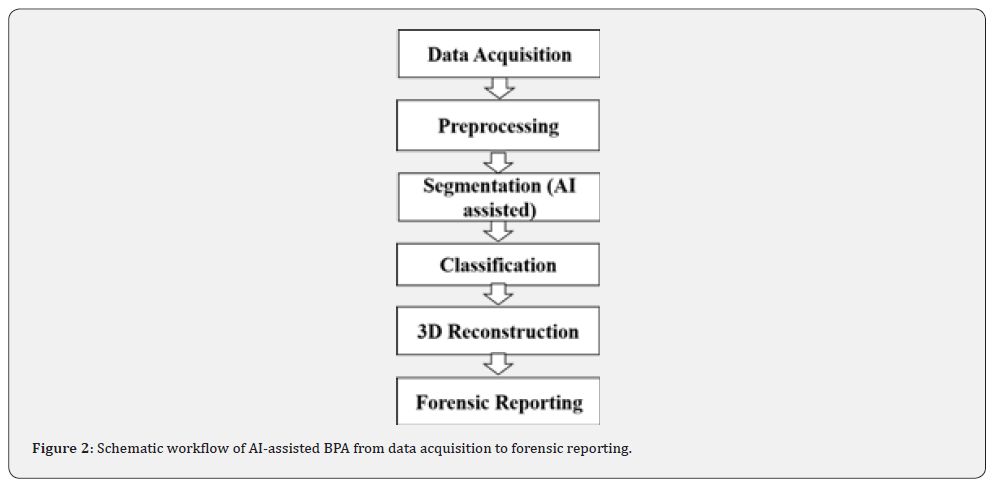
These quantifiable characteristics make BPA well suited for analysis by AI algorithms, which can identify and categorize morphological details more reliably than human analysts [17-19]. However, the conventional BPA technique is prone to problems such as overlapping patterns, degradation due to environmental factors, and subjective interpretation by the analyst, which AI methods aim to overcome [2, 20] (Figure 2).
AI Applications in Bloodstain Pattern Analysis
Machine Learning (ML) Approaches
Machine learning radically changed bloodstain pattern analysis through the use of algorithms which includes Random Forests, Support Vector Machines (SVM), and k-Nearest Neighbors (k-NN) and allowing for the categorization of different types of bloodstains based on extracted features of digital images. This approach requires careful image preprocessing and feature engineering. In this approach location of stains and attributes like stain shape, major and minor axis lengths, area, solidity, impact and orientation angles, shade, and space distribution measured and outlined per pattern are extracted. Identification of these properties helps in making a finer distinction between intricate patterns generated by different mechanisms. Ensemble learning techniques like Random Forest and boosting algorithms (XGBoost) have shown notably higher classification accuracy, above 92%, in the classification of blood patterns. Support Vector Machines (SVMs) and k-Nearest Neighbors (k-NN) also perform well but have relatively lower accuracy compared to ensemble learning techniques. Furthermore, Convolutional Neural Networks (CNNs), which can learn image features automatically without any feature extraction, have shown higher classification accuracy for classes like passive, projected, and transfer stains [8].
Deep Learning (DL) and Computer Vision
Computer vision and deep learning have made great strides in BPA, allowing for complex tasks such as stain classification, image segmentation, and trajectory analysis to be performed with high accuracy. Specifically, Convolutional Neural Networks (CNNs) are highly effective at identifying strong spatial features from bloodstain images, making it possible to classify stains with high accuracy into passive, projected, or transfer stains, often beating human experts in controlled experiments. Some research has found a high level of classification accuracy, with an accuracy of 95% and an F1-score of 0.95 for a three-class stain classification problem, outperforming traditional machine learning approaches in both success and precision [8,11, 21-24].
A critical step for separating stains from background images which is image segmentation, has been improved with thresholding algorithms and CNN-based models, including Otsu’s model, allowing for more accurate boundary detection of stains in cluttered or dynamic environments. The analysis of image trajectories through image processing and deep learning techniques allows for the calculation of impact angles, stain centres, and spatial trajectories. Prototype research has found that CNNs and other deep learning models can beat human experts in BPA classification tasks, especially when large amounts of data and subtle distinctions between stains are involved [11,23,24].
3D Modelling and Simulation
AI-assisted 3D modelling and simulation have emerged as important technologies in contemporary forensic BPA, allowing researchers to recreate complex crime scenes with a high degree of accuracy and detail. By using computer vision and deep learning algorithms, researchers can interpret photographic evidence of blood spatter patterns and recreate them as highly accurate 3D models, which can then be used to estimate the trajectory of blood droplets and points of origin in a virtual environment. These AI-assisted models can be created using multimodal scene data of various types, such as bloodstain patterns, object positioning, and spatial relationships, to create scientifically valid visualizations [25-27].
One of the most significant developments in this area is the use of these 3D models in virtual reality software for presentation in court. Immersive presentation allows judges, prosecutors, defence attorneys, and jurors to explore the virtual environment of the crime scene, view blood spatter patterns from various angles, and better understand the spatial relationships of the crime scene. As these technologies continue to evolve, AI-assisted 3D modelling combined with virtual reality is on the cusp of revolutionizing the presentation of forensic evidence in court [26-28].
Hybrid AI-Physics Approaches
This is the integration of physics’ rigid and rule-based approach with the fluidity and data intelligence of AI, particularly deep learning [7]. Computational Fluid Dynamics (CFD), a physics- driven model replicates the fluid motion of droplet creation, trajectory, impact dynamics, and spatter pattern formation by solving equations for air currents, gravity, viscosity, and surface tension. The result is a physically realistic simulation dataset characterizing the behaviour of blood under all sorts of conditions such as force intensity, angle, and environmental factors [29,30].
The integration of AI, and more specifically, deep learning models, makes it possible for these datasets to facilitate the development of models for identifying subtle correlations between physical variables and physical characteristics of stains [7]. The incorporation enables AI to interpret physically simulated data or real-world image data with greater situational understanding, leading to greater precision in classification, source identification, and mechanism identification. Hybrid models have the capability to distinguish between bloodstain patterns created by different ballistic or blunt trauma events by assessing the fluid dynamic patterns incorporated within the stains, which could be beyond analysis with purely statistical or machine learning approaches [31].
In real-world applications, this partnership enhances the reliability of automated forensic tools by reducing the incidence of false positives and false negatives, while also providing forensic analysts with products that are explainable and based on physical principles [32]. Beyond this, these research form the key for generating synthetic training data for machine intelligence, thus boosting the generalization of the model by providing exposure to a broader and physically correct range of bloodstain events than might exist in limited experimental or case datasets [31,32].
Proposed Framework
We have proposed a framework of nine elements to help reduce
concerns regarding reproducibility gaps, limited generalizability,
and legality surrounding AI-assisted Bloodstain Pattern
Analysis.
(1) Quality Verification of the Dataset: Concerns having the
appropriately sized and diverse dataset for a study. This consists
of all the possible volume blood, substrates, lighting, and impact
parameters. We also recommend minimum threshold sample sizes
and acceptable levels of reliability for the annotation (e.g., κ ≥
0.80) to minimize bias and risk of overfitting.
(2) Transparency of Algorithms: Requires the user to provide
full disclosure regarding the model, its configuration, and
training parameters, as well as explain the techniques used to create
it (i.e., Grad-CAM). Further, the user must be able to offer their
outputs in terms of probabilities, auditable codes, and all relevant
output files so that the results can be replicated by others for review
in judicial setting if necessary.
(3) Laboratory Performance Testing: Recommends a progressive
validation strategy that begins with standardized synthetic
stains, progresses to simulated casework with mock crime
scenes, and also includes analysis of previously solved cases. The
objective is to enhance the accuracy of AI in actual scenarios.
(4) Inter-rater Reliability Assessments: Recommended to
establish whether AI systems are equivalent to or better than human
performance and must be measured by concordance assessment
conducted by qualified BPA examiners. Acceptable levels of
agreement are κ ≥ 0.80, with acceptable error rates of ≤5% in each
category is advised.
(5) Thoroughly Documenting System: It is essential to document
the system comprehensively, including unaltered probabilistic
results, decision-making rationale, and maintaining electronic
records amenable to audit. This is helpful for quality assurance
and provides sound, admissible evidence for court.
(6) Admissibility Evaluation: Validation must be Daubert/
Frye compliant. This involves the publication of peer-reviewed
research studies that have known error rates (preferably <8%),
use standardized testing protocols, and gain acceptance among
several laboratories.
(7) Training and Qualification: Define the areas in which
operators must be qualified, which include basic AI knowledge,
interpretation skills, hands-on training, and education.
(8) Error Rate Monitoring: This guideline stresses the importance
of monitoring performance over the long term by maintaining
quality control and monitoring for drift. This is necessary
for ensuring that AI and BPA system continue to function correctly
over time.
(9) Deployment Guidelines: It is recommended to deploy
the AI-assisted BPA system in stages. The stages include Parallel
Testing, Consultative Use, and Primary Classification of the system,
with human oversight in all stages.
This approach mitigates risk while still enabling the development
of Institutional Trust and Competency. To guarantee utility,
the proposed framework must be validated empirically by:
(1) developing consensus among experts (such as the Delphi
technique among BPA practitioners, AI researchers, and legal
scholars),
(2) pilot testing in various forensic labs,
(3) evaluating outcomes to compare framework-assisted
adoption with ad hoc adoption, and
(4) refining based on feedback. A limitation of the proposed
framework is that since this framework is a conceptual integration
based on the existing literature and known forensic practices;
the proposed thresholds and criteria must be validated empirically
before they can be formally standardized.
Advantages of AI-Assisted BPA over Traditional Methodologies
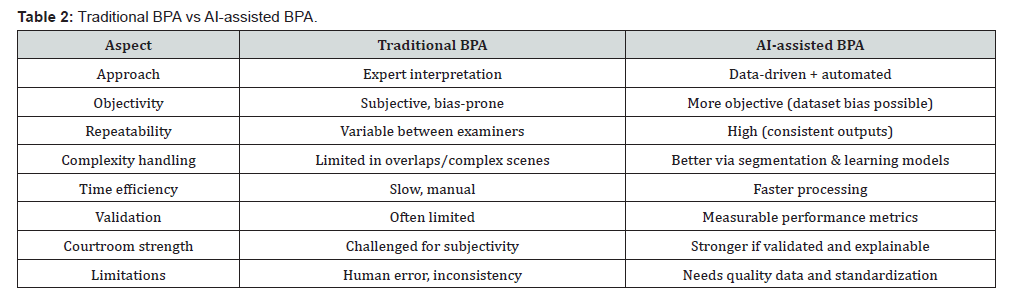
Reliability: AI systems, particularly deep learning architectures such as CNNs, attain greater levels of classification accuracy (e.g., >90%) for difficult bloodstain patterns [4,14]. Human professionals are subject to variation with experience and are susceptible to inferential errors, exhaustion, or personal interpretation at times giving rise to discrepancies as well as invalid results [33]. Promptness and Efficacy: AI has the ability to analyse large amounts of data or images in a reduced timeframe, which is more effective than human analysts who take longer to analyse data [34]. The application of AI has made possible routine identification, division, and interpretation of blood spots allowing forensic investigator to address analytically challenging cases and streamline repetitive workflows [24].
Advanced Data Management: AI does best at interpreting high-level, high-dimensional image features like stain morphology, distribution of stains across the image, and fine gradations of colour. Human professionals depend greatly on visual evaluation, whereby their capabilities could be restricted from integrating multidimensional data holistically [3,4]. Integration Potential: AI systems integrate seamlessly with additional forensic software, 3D modelling, as well as distributed legal frameworks, enabling safe, combined, and transparent evidence management for the purpose of investigations [27]. AI tools function as decision-making systems, aiding human experts by delivering swift preliminary assessments, identifying critical evidence points for comprehensive examination, and acting as an additional consultation in uncertain situations [34]. A comparison between traditional BPA and AI-assisted BPA is summarized in Table 2.
Current Research Trends
A strong trend toward digitalization, and automation has been seen in recent studies from 2024-2025 within AI-assisted BPA research. Supervised and unsupervised machine learning classifiers, such as XGBoost, Random Forest, and Convolutional Neural Networks (CNNs), distinguish patterns like impact spatter, swing, and cessation with accuracies between 80% to 99% [4,8,12,13]. Segmentation models, specifically fine-tuned SAM, achieve an accuracy between 97% to 99% in demarcating bloodstains on a complex background based on prompts, and allowing automated calculation of metrics for trajectory analysis [3].
Current BPA research is being conducted by cross-disciplinary teams consisting of BPA practitioners and other disciplines to create comprehensive, annotated databases of bloodstain images with the goal of optimizing the training of algorithms and improving the ability of those algorithms to discriminate between bloodstains based on patterns [3]. Innovative approaches to utilize multispectral and hyperspectral imaging, 3D scanning technologies for bloodstain analysis have greatly improved the sensitivity and specificity of bloodstain detection. As a result, efforts are ongoing to create an automated process for identifying the substances that comprise bloodstains and distinguishing blood from contaminants [13].
Critical Research Gaps and Future Directions
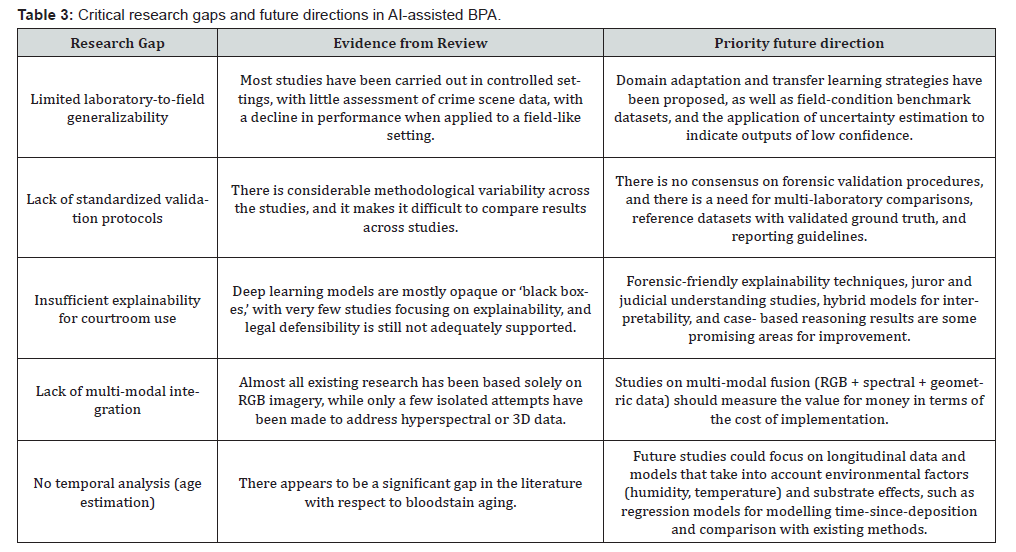
Key shortcomings still block real world use of AI in BPA. Challenges appear across methods, technicalities, and everyday applications which are outlined in Table 3. The coming innovations in AI-assisted BPA will be mainly directed towards three significant points; firstly, the enhancement of courtroom admissibility and the building of stakeholder trust through explainable AI methods [35], secondly, the consolidation with cutting-edge imaging technologies (3D scanning, hyperspectral, thermal) for thorough multi-modal assessment [13], and finally, the development of interactive visualization systems that facilitate spatial relationship comprehension among forensic scientists, legal professionals, and jurors [35]. The primary goal of these developments is to achieve higher precision, fewer mistakes, and to upgrade BPA as a field in which objective and reproducible results are obtained.
Limitations and Ethical Concerns of AI-assisted Blood Pattern Analysis
Limitations
These AI models need extensive high-quality annotated datasets for training; their quality may decline when challenged with novel or original data [3]. At times when AI behaves like a “black box” with lower explanations than human reasoning, problems are created for courtroom acceptability [36]. Forensic results are often more appropriate when artificial intelligence assists human experts by enhancing the efficiency of routine analysis and delivering evidence-based suggestions, while experts analyse results by combining contextual understanding and expertise [7]. In general, AI offers optimized performance, objectivity, and reliability with improved precision. On the other hand, meticulous analysis, holistic case assessment, and monitoring are critical properties of human expertise [7]. The combination of both aspects is essential to the development of forensic bloodstain analysis.
Ethical Concerns
The ethics of applying AI to BPA revolve around issues of fairness in algorithms, the explainability of models, accountability for regulations, and the management of data. If the data that the AI algorithms are trained and tested on is not diverse or representative, they can perpetuate biases and come to wrong conclusions, which can have severe legal implications [34]. The “black box” nature of various AI systems, particularly deep learning systems, makes it difficult to explain how an AI system arrives at its conclusions. This can create challenges for forensic experts, lawyers, and courts who must be able to understand, and even verify, how an AI system arrived at its conclusions [36]. When AI-generated evidence is at issue, the challenge of establishing transparency becomes even more difficult to achieve in a manner that is admissible in court.
If a problem arises, it is often difficult to determine whether it is the fault of the individuals who developed the algorithm or the forensic experts who employed it. In addition, the data that underlies the forensic analysis is often sensitive, such that there are significant requirements to avoid disclosing private information and to maintain data security [36-38]. There are also more general risks associated with the use of AI technology that can be used to produce or forge evidence, whether intentionally or inadvertently [19]. To address these ethical issues, it is necessary to insist on high levels of validation, bias removal, complete transparency, accountability for evidence use, and strict data protection measures [37]. It is only when a sound ethical foundation such as this is established that the integration of AI technology into BPA can be considered socially responsible.
Conclusion
This review compiled the findings from research on the use of Artificial Intelligence in Bloodstain Pattern Analysis. It has espe cially focused on the classification approaches, the nature of the datasets, the validation methods, and the performance evaluation. The papers studied show that different AI-assisted frameworks, matured from simple to complex models of machine learning (like Random Forest and XGBoost) to deep learning methods (such as CNNs and hyperspectral neural networks), have very high classification accuracy if used under proper experimental conditions.
These results affirm the scientific worth of AI-assisted BPA as a means of making bloodstain evidence interpretation more objective, faster, and repeatable since it will no longer be totally reliant on the skill of the examiner and will provide uniformity throughout the evaluations. The fact that models are subjected to different scenarios, such as different capture settings, distances, and methods of assessing images, will result in a degradation of performance. This points to the fact that many current AI models, which are trained on lab settings with controlled data, may not be able to generalize the variability that is seen in real-world crime scenes.
This is further exacerbated by real-world problems such as small, non-standardized datasets, lack of standardization in validation procedures, and a lack of standardization in the reporting of evaluation metrics. Scientifically speaking, this review would like to stress that the future application of AI-assisted BPA in the forensic field should be carried out in conjunction with standardized and diverse datasets, validation processes including external and cross-laboratory validation, and the use of explainable AI models that can help facilitate transparency and admissibility. In general, the role of AI-assisted BPA should be that of an empirically validated decision-support system functioning as a complement, not a replacement, for forensic experts.
References
- National Forensic Science Technology Center (NFSTC) A simplified guide to bloodstain pattern analysis, NFSTC, Largo, FL, USA, n.d.
- Forensic Science Regulator (2025) Codes of practice and conduct: Bloodstain pattern analysis (accessible), GOV.UK.
- Dong Z, Zhang Z (2023) Enhancing Bloodstain Analysis Through AI-Based Segmentation: Leveraging Segment Anything Model for Crime Scene Investigation.
- Jung H, Jo YS, Ahn Y, Jeong J, Lim SK (2024) A first step towards a machine learning-based framework for bloodstain classification in forensic science. Forensic Science International 365: 112278.
- Nirupama GS (2024) Advances in forensic bloodstain pattern analysis: a review of current methods and future directions. Int J Innov Res Technol 11(5): 2366.
- Ketsekioulafis I, Filandrianos G, Katsos K, Thomas K, Spiliopoulou C, et al. (2024) Artificial Intelligence in Forensic Sciences: a systematic review of past and current applications and future perspectives. Cureus 16(9).
- Ravivarma N (2021) Development of an Artificial Intelligence Method for the Analysis of Bloodstain Patterns. University of Central Oklahoma.
- Li Y, Shen W (2025) From Images to Detection: Machine Learning for Blood Pattern Classification.
- Sedik A, Kolivand H, Albeedan M (2025) An efficient image classification and segmentation method for crime investigation applications. Multimedia Tools and Applications 84(18): 19399-19423.
- Sheth TB, Shah MS (2023) A Discrete Wavelet Transform and Dense CNN for Hyperspectral Imaging-Based Bloodstain Classification. Indian Journal of Science and Technology 16(42): 3795-3802.
- Butt MH, Ayaz H, Ahmad M, Li JP, Kuleev R (2022) A fast and compact hybrid CNN for hyperspectral imaging-based bloodstain classification. In2022 IEEE Congress on Evolutionary Computation (CEC) 18: 1-8.
- Bergman T, Klöden M, Dreßler J, Labudde D (2022) Automatic classification of bloodstains with deep learning methods. KI-Künstliche Intelligenz 36(2): 135-141.
- Książek K, Romaszewski M, Głomb P, Grabowski B, Cholewa M (2020) Blood stain classification with hyperspectral imaging and deep neural networks. Sensors 20(22): 6666.
- Liu Y, Attinger D, De Brabanter K (2020) Automatic classification of bloodstain patterns caused by gunshot and blunt impact at various distances. Journal of forensic sciences 65(3): 729-743.
- Sacco MA, Gualtieri S, Princi A, Raffaele R, Aquila I (2025) Application of bloodstain pattern analysis (BPA) to reconstruct a staged crime scene in a complex forensic case. Forensic Science International: Synergy 11: 100624.
- Bell S (2025) Forensic science: an introduction to scientific and investigative techniques. CRC press.
- Organization of Scientific Area Committees (OSAC) for Forensic Science, Bloodstain Pattern Analysis Subcommittee, OSAC 2022-S-0030: Standard Methodology in Bloodstain Pattern Analysis 2023.
- Houck MM, Crispino F, McAdam T (2017) The science of crime scenes. Academic Press.
- Ponto L (2024) Bloodstain pattern analysis: decoding the language of crime scenes. J Forensic Med 9(1): 339.
- Brodbeck S (2012) Introduction to bloodstain pattern analysis. J Police Sci Pract 2(51): 51-57.
- Joris P, Jenar E, Moermans R, Van de Voorde W, Vandermeulen D, et al. (2022) Bloodstain impact pattern Area of Origin estimation using least-squares angles: A HemoVision validation study. Forensic Science International 333: 111211.
- Sarıbey AY, Ocak FN (2025) Forward Spatter Bloodstain Pattern Analysis: AO Estimation Using Image Processing and Numerical Modeling. Forensic Science International: Reports 18: 100416.
- Kim HH, Jeong WC, Ko YS, Park YJ (2024) Understanding Stain Separation Improves Cross-Scanner Adenocarcinoma Segmentation with Joint Multi-Task Learning. Stud Health Technol Inform 327: 53-57.
- Rough R, Batchelor O, Green R, Bainbridge-Smith A (2024) An automated method for the generation of bloodstain pattern metrics from images of blood spatter patterns. Forensic Science International 363: 112200.
- Villa C, Lynnerup N, Jacobsen C (2023) A virtual, 3D multimodal approach to victim and crime scene reconstruction. Diagnostics 13(17): 2764.
- wedvShenoy SU, Nagar V, Akhith A (2023) Artificial intelligence-based techniques for crime scene reconstruction and investigation: An overview. Journal of Forensic Research 14(4): 557.
- Divya I, Vybhavi B, Marimuthu M, Suchithra B, Keerthana NV (2025) AI-Driven Forensic Investigation: Automated 3D Reconstruction and Evidence Visualization. In 2025 International Conference on Next Generation Information System Engineering (NGISE) 1: 1-6.
- Home PH, Norman DG, Wade K, Spearing E, Williams MA (2024) 3D scanning a crime scene to enhance juror understanding of Bloodstain Pattern Analysis evidence. Science & Justice 64(3): 333-338.
- Laan N, de Bruin KG, Slenter D, Wilhelm J, Jermy M, et al. (2015) Bloodstain pattern analysis: implementation of a fluid dynamic model for position determination of victims. Scientific reports 5(1): 11461.
- Attinger D, Moore C, Donaldson A, Jafari A, Stone HA (2013) Fluid dynamics topics in bloodstain pattern analysis: Comparative review and research opportunities. Forensic science international 231(1-3): 375-396.
- Vasconcellos LG (2024) Advanced Computational Fluid Dynamics in Bloodstain Pattern Analysis: Investigating Non-Newtonian Properties for Forensic Applications.
- Siogkas PK, Pleouras D, Pezoulas V, Kigka V, Tsakanikas V, et al. (2024) Combining computational fluid dynamics, structural analysis, and machine learning to predict cerebrovascular events: a mild ML approach. Diagnostics 14(19): 2204.
- Hicklin RA, Winer KR, Kish PE, Parks CL, Chapman W, et al. (2021) Accuracy and reproducibility of conclusions by forensic bloodstain pattern analysts. Forensic Science International 325: 110856.
- Farber S (2025) AI as a decision support tool in forensic image analysis: A pilot study on integrating large language models into crime scene investigation workflows. Journal of Forensic Sciences 70(3): 932-943.
- Sirisathitkul C, Sirisathitkul Y (2025) Bloodstain in forensics: From visual inspections to AI-assisted pattern analysis and age estimation. History of science and technology 15(1): 26-46.
- Arjamand M, Saleem A, Basit A, Iftikhar S, Sharif M, et al. (2024) The role of artificial intelligence in forensic science: Transforming investigations through technology. International Journal of Multidisciplinary Research and Publications (IJMRAP) 7(5): 67-70.
- Kosta S, Jain DS, Suwalka DI () AI Revolutionizing Forensic Analysis: Enhancing Efficiency and Accuracy in Crime Investigation.
- Cărcăle VA (2025) The Future of Artificial Intelligence (AI) Applications in Forensics.

























