




 JFSCI Home



Abstract
Although there may be some cases when and/or where an accident can be reconstructed electively without the use of calculations and without the use of investigative and experimental data, such cases are rare. Aside from gravitational forces, aerodynamic forces, and inter-vehicular forces developed during collisions, the forces and moments generated by the interaction between the tires of a vehicle and the road surface control the motion of a vehicle. Hence, before reconstruction of road accidents, experts must have knowledge of fundamental physics. In a motor vehicle accident, when a car and a motorcycle collide and riders typically become independent, each follow their own path to rest. Consequently, the biomechanical analysis of motorcycle accident reconstruction is complex. This paper will help to explain crime scene activities, including two-wheeler and four-wheeler accidents. A case study is presented, demonstrating how the presented evidence can be used to analyze even after a long time gone between collisions involving a bike and four-wheeler.
Keywords: Reconstruction; Skid-marks; Yaw marks; Hit n run; SOC
Abbreviations: RTA: Road Traffic Accidents
Introduction
Reconstruction - Forensic reconstruction is the process of recreating the scenario of a crime, accident, or past event using scientific methods and techniques. This can include reconstructing facial reconstruction, determining the sequence of events in a crime (crime scene reconstruction), or recreating a physical environment such as a vehicle crash. The goal is to provide a visual representation that can help investigators and juries to understand what happened and potentially identify individuals involved as it combines principles from forensic science, logic, basic sciences, anatomy, and art.
Value of forensic evidence in reconstruction - Forensic evidence plays a crucial role in reconstruction by providing objective data that can be used to accurately arrange events surrounding a crime or accident. It includes physical evidence like
• Bloodstains
• DNA
• Fingerprints
• Ballistic Marks
• Trace Materials and Many More
These can be scientifically analysed to establish timelines, identify suspects, determine causes of death, or examine witness statements? The reliability and specificity of forensic evidence help to create a factual basis for the reconstruction, making it a important tool in the pursuit of justice by helping to clarify what occurred and how it occurred [1]. What is an accident reconstruction in road traffic accidents (RTA) - It is a process of analyzing and re-creating events during, and after a vehicular accident to determine how it occurred.
This involves examination of physical evidence such as skid marks, vehicles damage involved in accident, circumstantial conditions of road and witness statements. Forensic experts use this data to simulate the accident, often with the help of software/ models, to establish factors like speed, impact, and driver actions. The goal of reconstruction of RTA is to provide a clear and detailed understanding of the accident, which can be used in legal proceedings [2].
Evolution of RTA and Analysis
1. Accuracy: Forensic reconstruction relies on objective, scientific methods, making it a reliable tool for understanding the sequence of events. Techniques like bloodstain pattern analysis, scattering of debris, skid mark, yaw mark patterns and sometime firearm used then ballistics provide precise data that can clarify how the crime was committed [3-4].
2. Evidence Corroboration: By integrating various types of evidence e.g., physical, biological, testimonies, forensic reconstruction can reveal inconsistencies in witness theories, leading to a more accurate understanding of the crime.
3. Concept of Courtroom Utility: Reconstructions are powerful in court testimony, offering visual aids and detailed explanations that help judges and juries to understand complex aspects of a case which can significantly influence the outcome of a trial particularly while releasing fund or LICs or compensation to victim’s families.
4. Reconstruction useful to Identifying Offender (Suspect Involvement): Reconstruction can pinpoint critical details, such as the position of the v or the movements of suspects and victims, which can be crucial in identifying those involved in RTA or accident used as a crime to hide murder into an accident.
Case Study
In the present case study, we reported about unique and very vitally useful for forensic field expert those are working in the SOC or SOCO or AFO in Indian States. It was a case of hit n run in prima fascia, but when it is analyzed with all circumstantial evidence, it was case of murder, tried to be executed as accident (particularly Hit n Run case). Our finding and laboratory report confirm the evidence as a part of explaining to reconstruct the crime scene and correlate the evidence step by step. While reconstructing a crime is a team effort required, this team may involve the crime scene investigator, medical examiner, and law enforcement personnel. Information from the PMR, evaluation of the evidence and witnesses, and victim and suspect statements are combined to answer the questions of whom, how, where, and when. In this article our case suggested all these parameters consistently.
First Incident Response Report
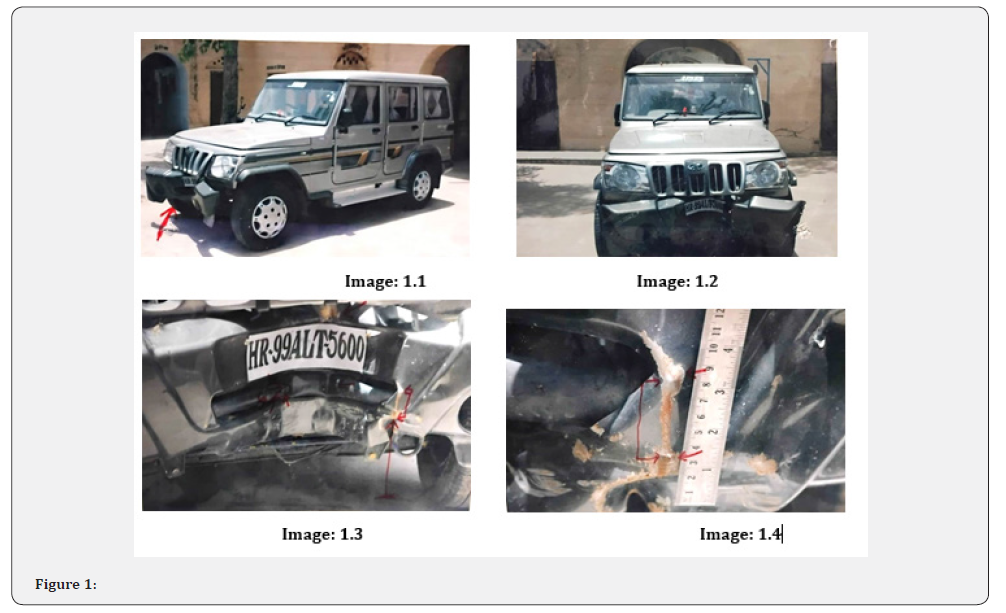
In this case, an unknown four-wheeler hit a bike (Motorcycle) and run from the scene of crime. After, this vehicle was found stroked on a tree. The driver or owner of the vehicle was claiming that he had an accident due to low visibility and collided with the tree.
Examination of Four-Wheeler: (Bolero)
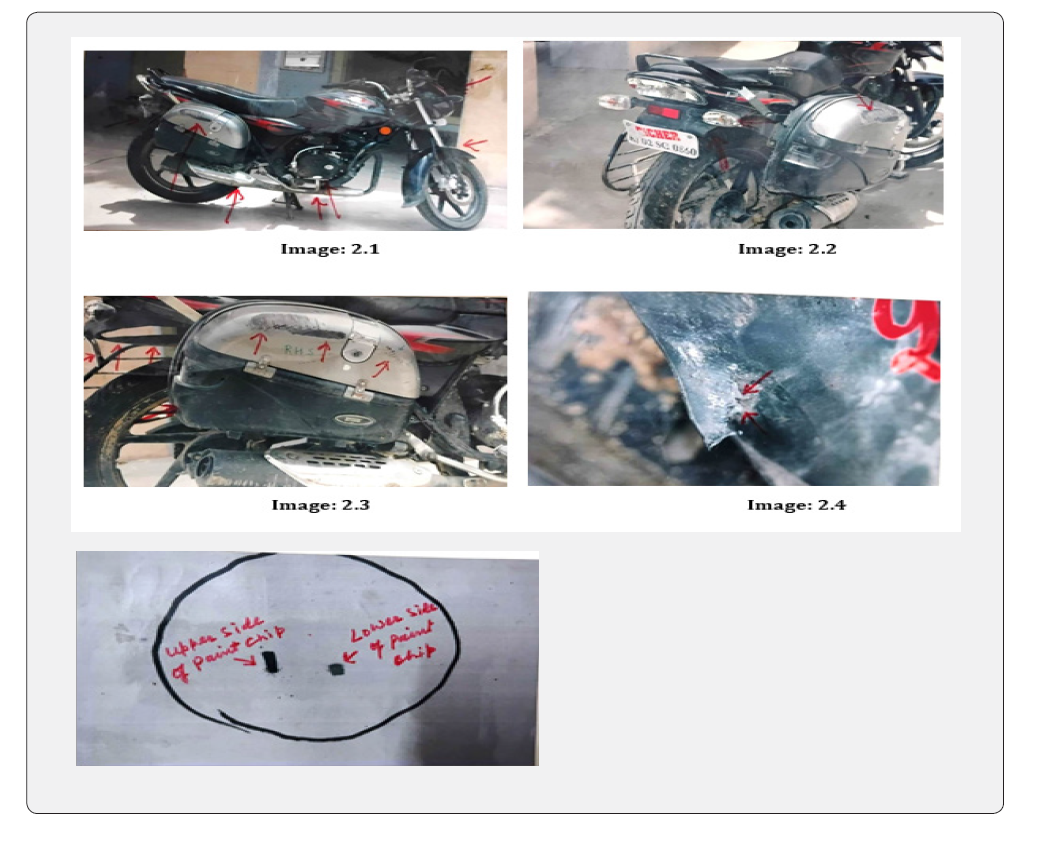
The vehicle was thoroughly examined and only a big dent was observed on the front metallic bumper, as shown in figure: 1.3, this big dent was made due to collision with tree as reported statement of the owner. We have been called to examine the vehicle and bike. Then we examined bike, which was deeply damaged from back side and having a high-speed impact from the rear side. We examine the bike thoroughly and find evidence like corresponding height with the collision location and a very minute colour paint chip entangled at the mudguard of the bike, which reveal the crime. The evidence proved collision between both vehicle Bolero car and bike (Figure 1, 2).
Laboratory Examination
In image 3 it is clearly observed that one paint chip was found entangled in the mudguard which is similar compared to the paint of Bolero vehicle in colour layer, sequence of layer and texture under microscopic examination.
Discussion
When a crime scene being recreated or reconstructed the concept of conclusion mainly depends on fourfold combination as;
1) Dependence on available evidence,
2) Complexity, sometimes crime scenes are far more
complex to be reconstruct because multiple factors or individuals
are involved and, in those cases, reconstruction only provides a
partial picture of crime scene,
3) Different reports, means reconstruction can be subject
to understanding various experts may give different conclusions
with same evidence, which can give a rise to dispute in trials and
4) Lack of resources, reconstruction sometimes requires
expensive technology and equipments, which is not available in
all cases [5-8].
Furthermore, the legal system’s reliance on forensic evidence has raised important ethical questions, particularly concerning privacy rights, the potential for misuse of technology, and the balance between security and civil liberties [9]. As forensic techniques become more sophisticated, particularly in areas like genetic testing and forensics methodology being attended, these ethical considerations will become increasingly significant while reaching at a conclusion of RTA reconstruction [10].
References
- S James, J Nordby, S Bell (2014) Forensic Science: An Introduction to Scientific and Investigative Techniques, 4th ed. CRC Press, Boca Raton, FL.
- WF Row (2014) Chapter in book of James S, Nordby J, and Bell S (2014) Forensic Science: An Introduction to Scientific and Investigative Techniques, 4th ed. CRC Press, Boca Raton, FL.
- R Saferstein (2011) Criminalistics, An Introduction to Forensic Science, 10th ed. Prentice Hall, Upper Saddle River, NJ.
- JA Siegel, K Kathy Mirakovits (2010) Forensic Science: Te Basics, CRC Press, Boca Raton, FL.
- H Franck, D Franck (2013) Forensic Engineering Fundamentals, 1st Edn, CRC Press, Boca Raton, FL.
- VM Nantulya, MR Reich (2002) The neglected epidemic: Road traffic injuries in developing countries. British Medical Journal 324(7346): 1139-1141.
- SH James, JJ Nordby, S Bell (2009) Forensic Science: An Introduction to Scientific and Investigative Techniques, 3rd Edn, CRC Press, Boca Raton, FL.
- Mukesh Sharma BS Khajja, DR Godara, GK Mathur (2011) Alleged Case of Theft and Murder Unravel by Forensic Investigation, Web-Online-Publication, Forensic Magazine 06-06-2011.
- S Kumar, P Jain, Mukesh Sharma (2016) Importance of Forensic Investigation in Explosion: A Case study. J Forensic Res 7: 347.
- KS Obenski (1994) Motorcycle Accident Reconstruction: Understanding Motorcycles. Lawyers & Judges Publishing Co.,Tucson, AZ.

























