




 JGWH Home



Introduction
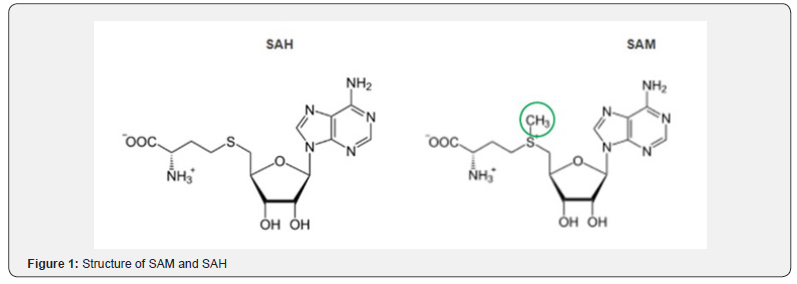
Methylation is a ubiquitous biochemical process that enables the addition of a methyl group to a wide variety of molecules, including neurotransmitters, lipids, proteins, RNAs, and DNA. Post-translational methylation of DNA-associated proteins, as well as DNA methylation itself, has profound effects on cell division and gene expression. The universal cofactor for methylation is SAM (S-adenosylmethionine), which is formed by the condensation of adenosine and methionine, an essential amino acid, in the presence of ATP. Following the transfer of the methyl group, S-adenosylhomocysteine (SAH) is produced (Figure 1), followed by homocysteine (Hcy), with an Hcy/SAH ratio of approximately 3. However, this ratio can be considerably higher in certain tissues. Both SAH and Hcy are inhibitors of numerous methyltransferases and so of methylation process by itself [1] Hcy may therefore be considered a cellular toxin. Serum homocysteine levels differ between men and women: a sexual dimorphism is present. Circulating Hcy higher in men (mean = 11.5 µM) than in women (mean = 8.5 µM). [2]
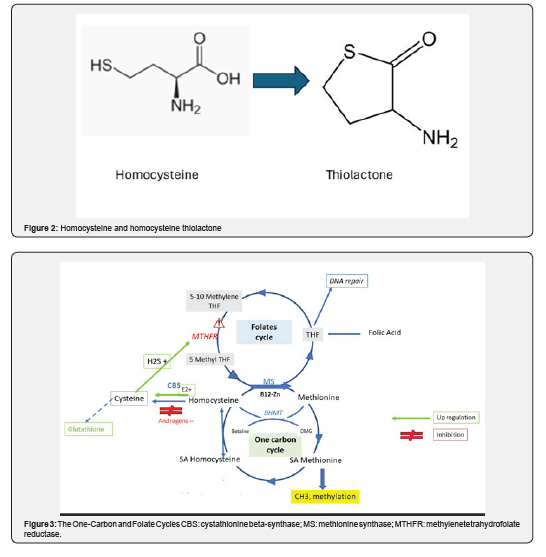
Homocysteine has an additional detrimental effect. Following cyclization, it is converted into homocysteine thiolactone (Hcy Thiolactone) (Figure 2), a strong pro-oxidant with a high affinity for lysine residues in proteins. This interaction (homocystinilation) can induce loss of tertiary protein structure and, in some cases, loss of enzymatic activity. Hyperhomocysteinemia is strongly implicated in the pathogenesis of numerous diseases, including cardiovascular, renal, ocular, and neurological disorders, as well as premature senescence and Alzheimer’s disease. It is also associated with infertility and major pregnancy and obstetrical complications [3,4], as methylation is an unavoidable and essential process for the transmission of life [5]. Hcy is recycled to methionine through the coordinated activity of two interconnected pathways: the folate cycle and the one-carbon cycle (1-CC, also known as the methionine cycle) (Figure 3). The enzyme responsible for this regeneration is methionine synthase (5-methyltetrahydrofolate--homocysteine methyltransferase), which is dependent on vitamin B12 and zinc. Both pathways are affected by numerous mutations and single-nucleotide polymorphisms (SNPs) that can reduce their overall activity. Among the most common and functionally significant are the MTHFR C677T and A1298C variants.
These SNPs can reduce enzymatic activity by up to 75% in the case of C677T. They increase circulating homocysteine levels, particularly in men, with concentrations that may reach 70 µM. The recycling of Hcy to methionine may also encounter an obstacle known as the “folate trap.” In the presence of vitamin B12 deficiency, methionine synthase activity is impaired, resulting in an accumulation of homocysteine. In our hands, the problem present in a young woman was resolved by a support of large doses of Cyanocobalamin [6]. In this article, we will explain why Hcy levels are more tightly regulated in women and how this regulation is related to hormonal status.
The One-Carbon Cycle and Hormonal Status: Impact on the CBS Pathway
Strict recycling of Hcy to methionine (Met) can occur through two different pathways. The first is the methionine synthase pathway, which requires vitamin B12, zinc, and 5-methyltetrahydrofolate (5-MTHF) originating from the folate cycle. This is the major pathway and is present in most tissues. The second pathway is the BHMT pathway, mediated by betaine-homocysteine methyltransferase and requiring betaine. It primarily facilitates methyl-group donation and is mainly present in the liver. It is generally considered to be of lesser importance. However, another pathway is involved in reducing circulating Hcy levels. Rather than recycling Hcy back to methionine and subsequently to SAM, this pathway leads to the formation of cysteine/cystine. This pathway is upregulated by estrogens [7,8] and downregulated by androgens [9].
Cystine is a precursor of glutathione, the “control tower” of cellular defense against oxidative stress. Cysteine is also the source of H₂S, a gasotransmitter that can positively affect proteins through S-sulfhydration, a post-translational modification that increases the reactivity of cysteine residues [10]. It was recently demonstrated that H₂S increases the bioactivity of MTHFR under physiological conditions through S-sulfhydration of five cysteine residues/sites, Cys 32,130,131,193 and 306 [11]. This mechanism has a clear positive impact on the folate cycle and, consequently, on the recycling of Hcy, In experimental models, MTHFR activity is associated with trans-sulfuration/transsulhydration status, whereas H2S deficiency reduces MTHFR activity and increases the HCY level. In summary, the hormonally regulated CBS pathway contributes to the markedly different blood Hcy concentrations observed between men and women. It promotes the detoxification of Hcy through its degradation to cysteine/cystine and contributes to the upregulation of MTHFR activity, even in the presence of functionally deleterious SNPs.
Hormones, the One-Carbon Cycle, and Oxidative Stress
4.
It is generally accepted that women are better protected against oxidative stress than men. Oral contraception (OC) and hormone replacement therapy (HRT) have provided further support for this concept [12,13]. Glutathione (GSH; γ-L-glutamyl-L-cysteinyl glycine) is the “control tower” of overall cellular redox status and homeostasis [14]. As described above, estrogens have a positive impact on glutathione synthesis through activation of the CBS pathway. This phenomenon has been demonstrated particularly clearly in the context of cardiovascular disease [15], where estrogens decrease lipid peroxide levels. Glutathione also interacts with glutaredoxins, contributing to antioxidant defense.
Patients affected by endometriosis and polycystic ovary syndrome (PCOS) have reduced circulating glutathione levels. Similarly, an increased prevalence of the homozygous 677TT MTHFR variant has been observed among infertile patients with endometriosis. Endometriosis lies precisely at the crossroads between DNA methylation and oxidative stress [16,17]. However, cysteine is important not only because of its role in glutathione synthesis and H2S genesis. Cysteine restriction may also trigger autophagy. Hypo taurine, a potent antioxidant that protects the preimplantation embryo within the oviduct [18], is derived from cysteine sulfonic acid, a metabolite of cysteine. One major limitation, however, is the large number of mutations identified in the CBS pathway—more than 150—which may alter its efficiency [19,20]. Therefore, after long lasting infertility, determination of cystine levels may be of major interest, when mutation in the pathway can be suspected.
Conclusion
Homocysteine should not be viewed simply as a circulating cardiovascular biomarker. It is a central metabolic intermediate positioned at the intersection of methylation, folate metabolism, methionine metabolism, sulfur metabolism, and redox homeostasis. In women, particularly during the reproductive years, hormonal regulation may contribute to the maintenance of relatively low circulating Hcy concentrations by influencing both re-methylation and trans-sulfuration. The resulting availability of cysteine may simultaneously support glutathione synthesis and other sulfur-dependent pathways. The interactions among estradiol, CBS, H₂S, MTHFR, glutathione, and Hcy offers an intriguing mechanistic framework for understanding aspects of female reproductive physiology. It may also provide a conceptual bridge between disturbances of one-carbon metabolism and reproductive disorders in which oxidative stress is prominent, including endometriosis and PCOS. However, several of these relationships remain mechanistic hypotheses rather than established clinical causation. In particular, the clinical significance of MTHFR polymorphisms1, MTHFR S-sulfhydration, estrogen-dependent regulation of trans-sulphuration, and Hcy lowering open therapeutic strategies for infertility. The central proposition is therefore not that homocysteine alone determines female fertility, but rather that Hcy is an important node within an interconnected metabolic network in which methylation capacity, sulfur metabolism, hormonal status, and redox homeostasis converge. Understanding this network may ultimately prove more informative than focusing on any single metabolite or genetic polymorphism. It seems that, Hcy must be surveyed at any age, during here fertile life and also during menopause.
References
- James SJ, Melnyk S, Pogribna M, Pogribny IP, Caudill MA (2002) Elevation in S-adenosylhomocysteine and DNA hypomethylation: potential epigenetic mechanism for homocysteine-related pathology. J Nutr 132(Suppl. 8): S2361–S2366.
- Chen NC, Yang F, Capecci LM, Gu Z, Schafer AI, et al. (2010) Regulation of homocysteine metabolism and methylation in human and mouse tissus. FASEBJ24(8) : 2804–2817.
- Clement A, Alvarez S, Jacquesson-Fournols L, Amar E, Brami C, et al. (2023) Women are More Protected than Men against HHcy (Hyperhomocysteinemia) during their Reproductive Life: Gender-Related Différences in One-Carbon and Folates Cycles Metabolism. Archives of Clinical and Biomedical Research 7: 345-352.
- Ménézo Y, Elder K, Clement A, Patrizio P, Brack M, et al. (2023) Homocysteine testing is a significant predictor of health for couples trying to conceive and their future children. Epigenomics 15(21): 1095-1099
- Dai C, Fei Y, Li J, Shi Y, X Yang, (2021) A Novel Review of Homocysteine and Pregnancy Complications. Biomed Res Int. 2021: 6652231.
- Menezo Y, Clement P, Clement A, Elder K (2020) Methylation: An Ineluctable Biochemical and Physiological Process Essential to the Transmission of Life. Int J Mol Sci 21(23): 9311.
- Clément A, Clément P, Viot G, et al. ( 2023) The importance of preconception Hcy testing: identification of a folate trap syndrome in a woman attending an assisted reproduction program. J Assist Reprod Genet 40(12): 2879-2883.
- Zhang D, Hong X, Wang J, Jiang Y, Zhang Y, et al., (2021) Estradiol-17β inhibits homocysteine mediated damage by promoting H2 S production via upregulating CBS and CSE expression in human umbilical vein endothelial cells. J Cell Biochem 122(9): 915-925.
- Wang H, Zhang L, Liu Y (2025) The Role and Research Progress of Cystathionine beta-Synthase in the Female Reproductive System. Comp Physiol 15(6): e70062.
- Vitvitsky V, Prudova A, Stabler S, et al. (2007) Testosterone regulation of renal cystathionine beta-synthase: implications for sex-dependent differences in plasma homocysteine levels. Am J Physiol Renal Physiol 293(2): F594-600.
- Paul BD, Snyder SH (2015) H2S: a Novel gasotransmitter that signals by sulfhydration. Trends Biochem Sci 40: 687–700.
- Ji D, Luo C, Liu J et al. (2022) Insufficient S-Sulfhydration of Methylenetetrahydrofolate Reductase Contributes to the Progress of Hyperhomocysteinemia. Antioxid Redox Signal 36(1-3): 1-14.
- Pincemail J, Vanbelle S, Gaspard U et al, Collette G, Haleng J, et al., (2007) Effect of different contraceptive methods on the oxidative stress status in women aged 40 48 years from the ELAN study in the province of Liege, Belgium. Hum Reprod 22(8): 2335-43.
- Pincemail J, Vanbelle S, Degrune F, Cheramy-Bien JP, Charlier C, et al., (2011) Lifestyle Behaviours and Plasma Vitamin C and β-Carotene Levels from the ELAN Population (Liège, Belgium). J Nutr Metab 2011: 494370.
- Aquilano K, Baldelli S, Ciriolo MR (2014) Glutathione: new roles in redox signaling for an old antioxidant. Front Pharmacol 5: 196.
- Dimitrova KR, DeGroot K, Myers AK, Kim YD (2002) Estrogen and homocysteine. Cardiovasc Res 53(3): 577-88.
- Menezo YJ, Silvestris E, Dale B, et al. (2016) Oxidative stress and alterations in DNA methylation: two sides of the same coin in reproduction. Reprod Biomed Online 33(6): 668-683.
- Koukoura O, Sifakis S, Spandidos DA (2016) DNA methylation in endometriosis (Review). Mol Med Rep13(4): 2939-2948.
- Guérin P, El Mouatassim S, Ménézo Y (2001) Oxidative stress and protection against reactive oxygen species in the pre-implantation embryo and its surroundings. Hum Reprod Update 7(2): 175-89.
- Zhang J, Lin X, Liu X, Lu Y, Tao D, et al. (2025) Unraveling CBS Mutations and Their Clinical Impact in a Chinese Family With Classical Homocystinuria. Mol Genet Genomic Med 13(9): e70132.